Workshop strengthens entrepreneurial teaching at TUT
Academics
8 July 2026
By Mosima Rafapa
Preparing graduates to create opportunities rather than wait for them was at the heart of an entrepreneurship workshop hosted by the Tshwane University of Technology’s Faculty of Engineering and the Built Environment (FEBE). During the event, academics gained practical knowledge and strategies to embed entrepreneurial thinking into teaching, research and innovation while strengthening the University's vision of developing future-ready graduates.
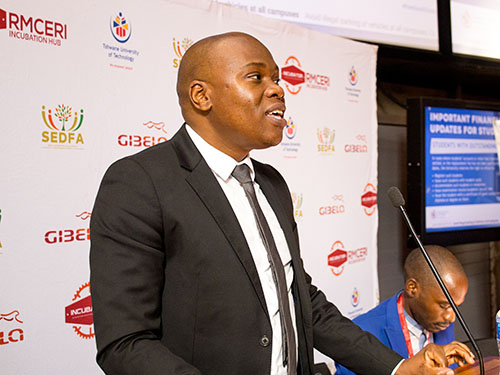 FEBE Executive Dean Prof Mxolisi Shongwe.
The workshop encouraged lecturers to embed entrepreneurship into everyday teaching, research and student development, equipping graduates to leave TUT with technical expertise as well as the confidence and skills to identify opportunities, solve real-world problems and create value for society.
FEBE Executive Dean Prof Mxolisi Shongwe.
The workshop encouraged lecturers to embed entrepreneurship into everyday teaching, research and student development, equipping graduates to leave TUT with technical expertise as well as the confidence and skills to identify opportunities, solve real-world problems and create value for society.
Opening the workshop, FEBE Executive Dean, Prof Mxolisi Shongwe, said universities can no longer rely on the assumption that industry will absorb all graduates.
“For decades, the traditional university model was simple: we graduate students and industry absorbs them. But today, that equation is broken. Industry cannot absorb them fast enough. As a leading University of Technology, we have a societal duty to shift from graduating job seekers to cultivating job creators.”
He encouraged academics to view themselves as architects of the curriculum, capable of inspiring entrepreneurial thinking in every classroom.
“The transformation starts with you. You are the architects of our curriculum. To embed entrepreneurship in the lecture hall, we must stop teaching engineering and the built environment in a vacuum. We must encourage risk-taking, teach design thinking and show students how to protect intellectual property.”
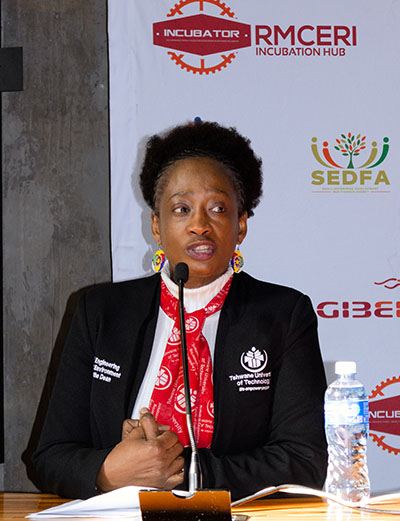 Assistant Dean for Teaching and Learning Prof Caroline Khoathane.
Prof Shongwe also highlighted the importance of stronger collaboration between academics, students, industry and incubation structures to ensure that research and innovation deliver meaningful economic and social value.
Assistant Dean for Teaching and Learning Prof Caroline Khoathane.
Prof Shongwe also highlighted the importance of stronger collaboration between academics, students, industry and incubation structures to ensure that research and innovation deliver meaningful economic and social value.
Prof Caroline Khoathane, Assistant Dean for Teaching and Learning at FEBE, said integrating entrepreneurship into curricula would help students identify opportunities, create value, build partnerships and respond creatively to changing needs.
“Integrating entrepreneurship in our curriculum will allow students to identify opportunities, create value, build partnerships and respond creatively to challenges, resulting in future-ready graduates who make a positive impact in society.”
Dr Patrick Ebewo, Acting Director of the Tshwane School for Business and Society/Centre for Entrepreneurship Development, described entrepreneurship as a transformational tool that should shape teaching, research and innovation across the University.
“Entrepreneurship is not an option anymore. It is a transformational tool for the University.”
He encouraged academics to develop engineers who look for opportunities, solve problems and create value. He also called on universities to ensure that patents, prototypes and research outputs progress from proof of concept to technology transfer, industry partnerships and commercial application.
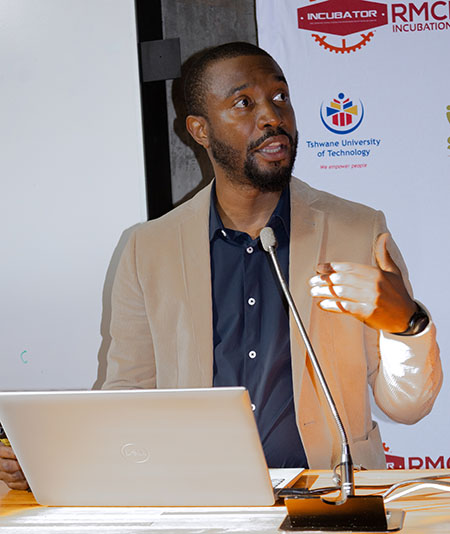 Acting Director of the Tshwane School for Business & Society/Centre for Entrepreneurship Development, Dr Patrick Ebewo.
“We must transition. It will be a process, but we can do it.”
Acting Director of the Tshwane School for Business & Society/Centre for Entrepreneurship Development, Dr Patrick Ebewo.
“We must transition. It will be a process, but we can do it.”
Mbali Blaai, Centre Manager of the Rail Manufacturing Centre for Entrepreneurship Rapid Incubator (RMCERI), said TUT already has a strong foundation for entrepreneurship and innovation.
“TUT is not starting from zero. We are building on an existing foundation of innovation and entrepreneurship.”
Drawing on engagements with universities in South Africa, the Netherlands and France, she explained that RMCERI has expanded its support from commercialising Industrial Engineering research to developing student entrepreneurs across the University.
“TUT already has 16 centres and institutes contributing to innovation and entrepreneurship, with seven based in FEBE.”
She encouraged academics to use the expertise and resources already available.
“You are not the gatekeepers of knowledge. You are catalysts of innovation.”
Matimba Phadagi, a fourth-year Electrical Engineering student, demonstrated the impact of entrepreneurial support at TUT.
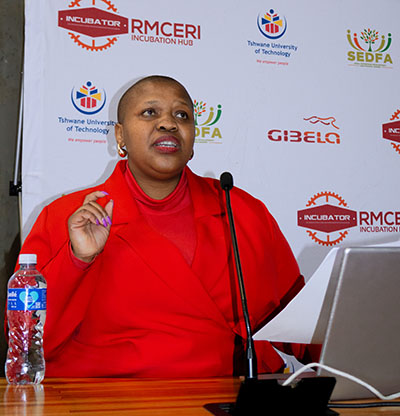 Mbali Blaai, Centre Manager of the Rail Manufacturing Centre for Entrepreneurship Rapid Incubator (RMCERI).
After reaching the final of the 2023 TUT Innovation Challenge, he joined the RMCERI, where mentorship and training helped him establish Matimba Phadagi Holdings in 2024. He has since become a founding member of the South African BRICS Youth Association and participated in international programmes that expanded his professional network across BRICS countries.
Mbali Blaai, Centre Manager of the Rail Manufacturing Centre for Entrepreneurship Rapid Incubator (RMCERI).
After reaching the final of the 2023 TUT Innovation Challenge, he joined the RMCERI, where mentorship and training helped him establish Matimba Phadagi Holdings in 2024. He has since become a founding member of the South African BRICS Youth Association and participated in international programmes that expanded his professional network across BRICS countries.
“What started as a student competition became a doorway to entrepreneurship and international opportunities I never imagined.”
Phadagi encouraged the University to continue investing in aspiring entrepreneurs, saying mentorship, training and innovation programmes give students the confidence to transform ideas into successful ventures.
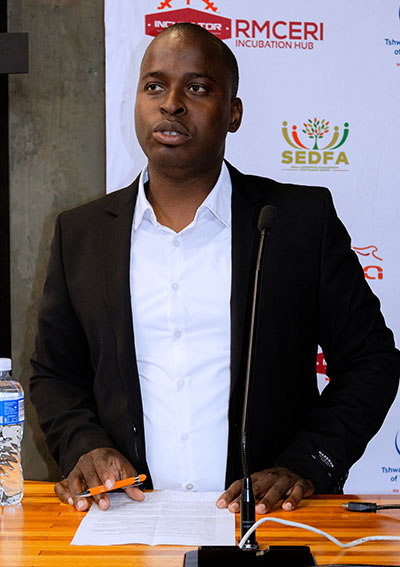 Fourth-year Electrical Engineering student Matimba Phadagi.
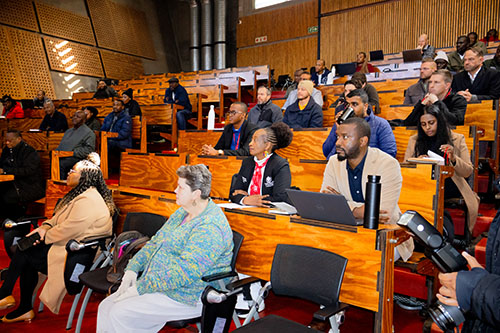 FEBE hosted an Entrepreneurship Workshop encouraging academics to integrate it into daily teaching, research, and student development, ensuring graduates leave TUT with technical skills and confidence to create opportunities.