Water queues inspire cum laude Engineering graduate’s research
AcademicsOther
4 May 2026
By Mosima Rafapa
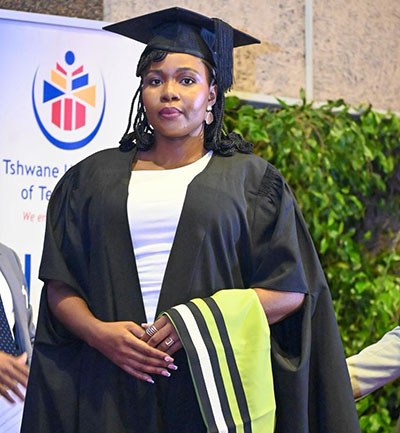
Samukelisiwe Nokuthula Mathenjwa earned a Master’s degree in Civil Engineering cum laude and channelled her research into tackling water access challenges shaped by her childhood experiences.
 Addressing water access and quality challenges in South Africa, her study titled Impact of climate and land use change on water resources in the Upper Vaal River Basin South Africa examines how environmental changes affect water availability and quality. Her findings show that reduced rainfall, rising temperatures, and agricultural activity are driving declining water quality due to increased nutrient runoff into rivers. Less rain and increased pollution result in less safe water for communities and ecosystems.
“It is about understanding what affects clean water and how we can improve it,” she says.
She believes engineers must respond to these challenges. “They must design systems that are climate resilient and ensure water is accessible to communities,” she says.
Mathenjwa’s achievement reflects a journey shaped by early experiences of water scarcity in the KwaFakude Village in Nongoma. After school, she walked long distances to a well and often returned with only 20 litres for her household if water was available.
“Sometimes you were lucky if the water was even clean,” she recalls.
Her interest in Civil Engineering started in Grade 9 when she saw the construction of an access road near her school. Curious, she asked about the profession of the person carrying drawings and wearing a white helmet, which introduced her to the field.
Her curiosity grew when her sister brought home books on Civil Engineering. She learned that engineers design systems that deliver services such as water to communities.
“I knew then that if I studied Civil Engineering, I could help solve the water challenges in my community and that vision became my anchor,” she says.
Raised in a family of seven siblings, Mathenjwa balanced her studies with herding her father’s goats. Her mother, a school principal, influenced her commitment to education.
“My mother instilled in us a belief in education. Through her resilience, I was inspired to follow her and I knew from a young age that education would open doors that would help me realise my dreams,” she explains.
Throughout her studies, she received support from her late supervisor, Prof Julius Ndambuki.
“He believed in my work and always reminded me that I can stumble but not to give up. Even when he was not happy with my progress, he still showed up for me,” she says.
She now aims to honour his legacy by continuing research focused on practical solutions to improve water access in rural communities.