TUT’s SunChaser 4 sets the pace at the 2026 Sasol Solar Challenge
Academics
17 September 2026
By Mosima Rafapa
When the sun rises over South Africa’s open roads, it is doing more than lighting the way for TUT’s SunChaser 4. For the students and staff behind the solar car, every kilometre is a chance to put months of engineering, testing and problem solving to work.
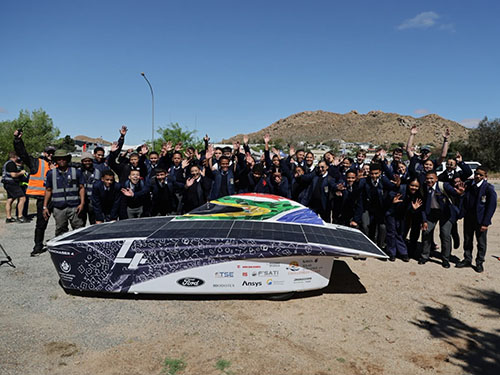 The SunChaser 4 team interacts with learners along its way.
The Tshwane University of Technology’s (TUT) Faculty of Engineering and the Built Environment (FEBE) is represented by the SunChaser 4 team at the 2026 Sasol Solar Challenge, where solar-powered vehicles are travelling more than 2 300km across South Africa from 10 to 17 September.
The SunChaser 4 team interacts with learners along its way.
The Tshwane University of Technology’s (TUT) Faculty of Engineering and the Built Environment (FEBE) is represented by the SunChaser 4 team at the 2026 Sasol Solar Challenge, where solar-powered vehicles are travelling more than 2 300km across South Africa from 10 to 17 September.
Before the team set off, its work had already caught industry attention. Students involved in the design and construction of SunChaser 4 received the License to Innovate Award from Ford Silverton Assembly Plant in recognition of their technical ingenuity, precision engineering and excellence in the vehicle’s design and build.
For the students, the award is recognition that the hours spent designing, building, testing and refining the vehicle have translated into a machine that must now perform beyond the classroom.
SunChaser 4 brings together different areas of engineering into a single working machine. Its lightweight carbon fibre body helps reduce overall mass, while the battery system and roof-mounted solar array are integrated to make effective use of solar energy.
On the road, however, there is nowhere to hide from a design that does not work.
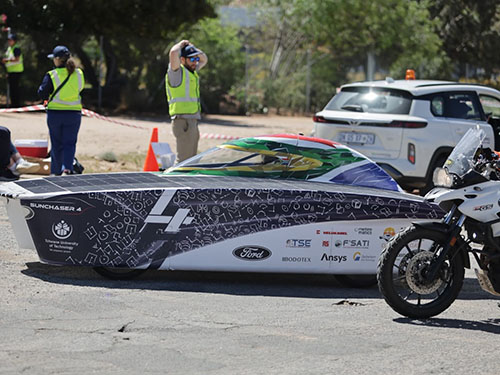 It has been quite a marvellous journey so far for the SunChaser 4, who are competing in the Sasol Solar Challenge.
Battery performance, energy management, vehicle efficiency, weather conditions, and team decisions all contribute to the engineering equation. Behind the vehicle is also a support operation involving equipment, supplies and logistics across thousands of kilometres.
It has been quite a marvellous journey so far for the SunChaser 4, who are competing in the Sasol Solar Challenge.
Battery performance, energy management, vehicle efficiency, weather conditions, and team decisions all contribute to the engineering equation. Behind the vehicle is also a support operation involving equipment, supplies and logistics across thousands of kilometres.
Ford South Africa has supported the TUT team with Ford vehicles and fuel, helping transport the students and technical crew throughout the challenge.
Team Director Dr Christiaan Oosthuizen said the challenge allows students to experience engineering beyond calculations and laboratory work.
“The Sasol Solar Challenge gives our students an opportunity to take what they have learned in the classroom and apply it in a real environment. They are making decisions, solving problems and seeing how their engineering choices perform under changing conditions,” said Dr Oosthuizen.
The experience is further strengthened by Ford’s technical support along the route, including technicians and a mobile workshop. The support has included 3D printing components for teams when required, allowing students to see how modern manufacturing technologies can be used to solve problems as they arise.
 “For our students, this is a valuable opportunity to experience agile problem solving, technical collaboration and advanced manufacturing in a demanding environment. They can see how an engineering problem can move from identification to design and manufacturing, and ultimately to a working solution, sometimes within a very short period,” said Dr Oosthuizen.
SunChaser 4 started the challenge in Sasolburg on 10 September, travelling through Magaliesburg before reaching its first control stop at Rustenburg High School.
The stop formed part of the challenge’s Schools Programme, which gives participating teams an opportunity to engage with learners along the route and introduce them to science, technology, engineering and mathematics.
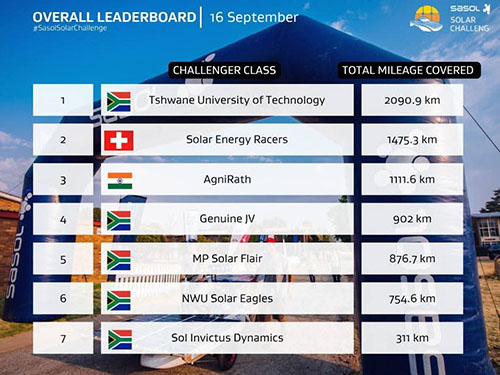
From the beginning, SunChaser 4 showed its potential, taking the lead in the Challenger Class and maintaining its position through the early stages of the challenge.
By Day 6, the team was still leading the Challenger Class. The team travelled 310 km from Augrabies to Springbok, putting the vehicle and its crew through another demanding day on the road.
For former TUT student and current driver Mpho Mogadima, the challenge represents a journey that has grown alongside his engineering career.
“I started my SunChaser journey during my in-service training in the Mechanical Skills Laboratory and officially became part of the team in 2019. I had the opportunity to drive in 2022, volunteered as an observer in 2024, and returned as a driver in 2026,” said Mogadima.
He said being part of the team has allowed him to experience engineering from design and manufacturing to assembly and testing, while working alongside people from different disciplines.
“SunChaser has played a big role in my growth, both personally and as an engineer. I have worked across different stages of the vehicle’s development and collaborated with students and colleagues in mechanical, electrical, mechatronics and industrial design. It has also given me the opportunity to share what I have learnt with other students, particularly in mechanical components and composite manufacturing,” he said.
For Mogadima, the journey has been challenging but rewarding.
“It has been a transformative experience, from being a student and learning the fundamentals, to becoming a staff member and applying that knowledge in practice. Now I can guide others and share the knowledge I gained along the way,” he said.