TUT’s research growth highlighted during Faculty visit
Academics
24 February 2026
By Kgothatso Monono
TUT’s Faculty of ICT hosted the 2025 Research, Innovation and Engagement Annual Performance Visit led by Dr Vathiswa Papu-Zamxaka, DVC Research, Innovation and Engagement, on 18 February 2026.
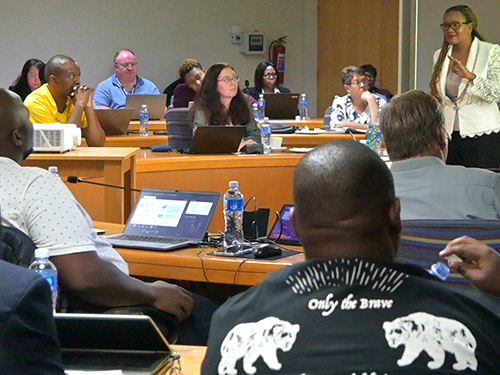 DVC performance visit FoICT.
The visit formed part of the Office of the DVC’s annual faculty engagements to assess research performance, innovation progress, postgraduate development, and internationalisation efforts across the University. Heads of Department (HODs), Faculty Research and Innovation Committee (FCRI) members, Faculty Committee for Postgraduate Studies (FCPS), Faculty Committee for Teaching and Learning (FCTL), academic staff, postdoctoral research fellows, staff with doctoral qualifications, staff currently pursuing doctorates, from various departments within the Faculty of ICT and the faculty marketer attended the session.
During her presentation, Dr Papu-Zamxaka highlighted TUT’s significant research performance growth. The University achieved 601 DHET-accredited research output units in 2024, representing a 30.4% increase from 2023 and surpassing the DHET target by 173 units. This marks an overall growth of 119.3% from 2021 (274 units) to 2024 (601 units), demonstrating strengthened research productivity and improved consolidation processes.
Rated researchers contributed 141.23 units (23.5%) of the total submission, reflecting the growing research capacity and competitiveness of the institution. TUT currently has 78 NRF-rated researchers, ranking 2nd among Universities of Technology nationally.
A key highlight of the visit was the remarkable contribution of Postdoctoral Research Fellows (PDRFs) to the University’s research output and innovation ecosystem.
Over the five-year period from 2020 to 2025, the number of postdoctoral research fellows grew impressively from 54 to 213, reflecting deliberate institutional investment in strengthening research capacity. The University also surpassed its 2025 target for postdoctoral fellows by 17.8%, achieving an overall growth of 32.3% from 2024. Out of the 601 research output units awarded, 11% has been contributed by Postdoctoral Research Fellows. Over the same period (2020-2025), a total of 11 new Research Chairs have been added, taking the institutional total to 18 Research Chairs.
TUT further strengthened its postdoctoral pipeline through a joint Postdoctoral Fellowship Programme with the University of Johannesburg and the University of the Witwatersrand.
While Master’s graduations met 100% of the DHET target, doctoral graduations reached 90.5%, indicating ongoing efforts to improve pipeline efficiency. The Directorate of Research and Innovation continues to provide research capacity-building workshops to support staff and student completion rates.
Importantly, the faculty’s academic qualification profile remains a priority, with continued encouragement for staff to pursue doctoral studies to strengthen supervision capacity and research leadership.
The Office of the DVC also shared progress in:
- External research funding, which reached R149 million nationally and R8.4 million internationally.
- Innovation growth through the Innovation and Technology Transfer Office (ITTO), including patents and multidisciplinary impact.
- Student and staff mobility programmes, which grew significantly between 2023 and 2025.
- Open access publishing and institutional repository expansion.
These achievements reinforce the University’s commitment to impactful research, innovation, and engagement aligned with national development priorities and global sustainability goals.
The Faculty of ICT continues to demonstrate strong academic and research leadership under the stewardship of Executive Dean, Dr Etienne van Wyk. His commitment to research development, postgraduate growth, and academic excellence has positioned the faculty as an active contributor to TUT’s overall research momentum.
Through strategic support for postdoctoral fellows, emerging researchers, and doctoral candidates, the Faculty of ICT remains focused on building a sustainable research culture that promotes innovation, industry engagement, and international competitiveness.
The Annual Performance Visit reaffirmed the Faculty of ICT’s commitment to advancing research, strengthening postgraduate supervision, supporting postdoctoral excellence, and fostering innovation.
The strong attendance of HODs, committee members, postdoctoral fellows, doctoral staff, and emerging scholars reflected a shared commitment to continuous improvement and strategic growth. As the University moves forward, established researchers remain central to driving high-impact scholarship and positioning the Faculty of ICT as a leader in research, innovation, and engagement.