TUT’s mulcher innovation on show at Nampo highlights the future of safer land clearing
Academics
20 May 2026
By Mosima Rafapa
A remote-controlled mulcher, developed by the Tshwane University of Technology (TUT) in collaboration with industry partner, Wuhlf Equipment, was on display at Nampo Harvest Day, the annual agricultural and trade mega-exhibition held in Bothaville, Free State.
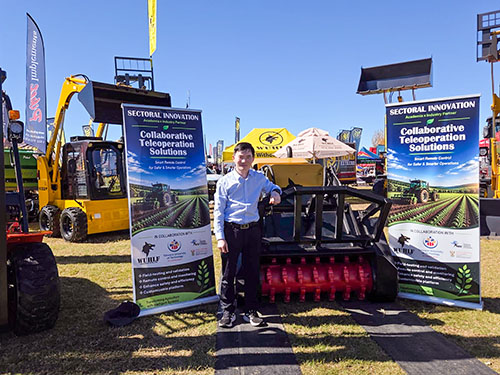 Prof Shengzhi Du at the 2026 Nampo Harvest Day, showcasing the remote-controlled mulcher TUT developed with industry partner Wuhlf Equipment.
Nampo, which took place from 12 to 15 May, features cutting-edge machinery, livestock and technological innovation. Visitors had the opportunity to see the prototype and to learn how technology and engineering innovation can support safer, more efficient land management in agriculture.
Prof Shengzhi Du at the 2026 Nampo Harvest Day, showcasing the remote-controlled mulcher TUT developed with industry partner Wuhlf Equipment.
Nampo, which took place from 12 to 15 May, features cutting-edge machinery, livestock and technological innovation. Visitors had the opportunity to see the prototype and to learn how technology and engineering innovation can support safer, more efficient land management in agriculture.
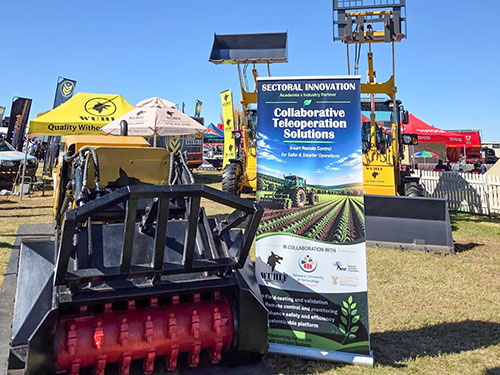
The machine, fitted with an 85kW engine, is designed to clear invasive species in steep, hazardous, or difficult-to-access areas, while human operators operate it remotely from a safe distance, using controls like those on the real machine.
Prof Shengzhi Du, who led the development of the prototype, said the collaboration between TUT and Wuhlf Equipment highlights the growing role of automation and smart engineering solutions in modern farming, particularly in reducing risks for operators working in challenging terrain. He added that it also demonstrates the University’s contribution to industry-driven innovation by applying research and engineering expertise to practical agricultural challenges.
 “Mechanical mulching has increasingly become an important tool for farmers and landowners seeking environmentally responsible ways to manage invasive species and restore grazing land. Industry experts note that these machines can improve land productivity while reducing reliance on extensive chemical control methods. The mulch left behind after clearing can also improve soil protection and moisture retention,” said Prof Du, a Full Professor in the Department of Electrical Engineering in the Faculty of Engineering and the Built Environment.
“By exhibiting the prototype at Nampo, TUT showcased how higher education institutions can partner with industry to develop technologies that improve productivity, sustainability and safety within the agricultural sector,” he added.
Prof Du is also the recently appointed Department of Science, Technology and Innovation-National Research Foundation (DSTI-NRF) Chair in Next-Generation Telemanipulation and Teleoperation Platforms for Multiple Sectors: Education, Training and Production, under the auspices of the South African Research Chair Initiative (SARChI). The Chair focuses on human-machine interfaces for challenging working environments across sectors such as mining, manufacturing, and underwater environments.
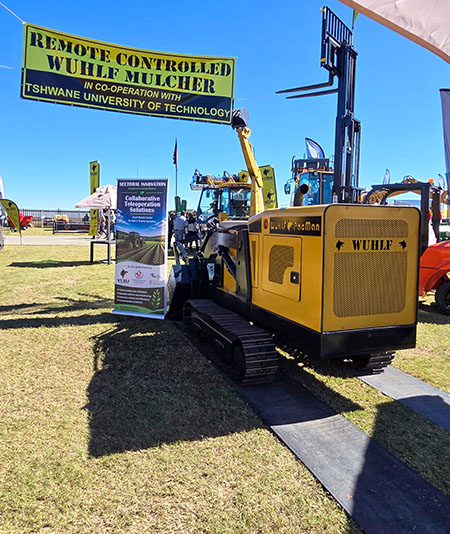 The remote-controlled mulcher developed by TUT in partnership with Wuhlf Equipment.