TUT symposium focuses on multivocality, interdisciplinarity and creative expressions in addressing GBVF
Academics
28 July 2026
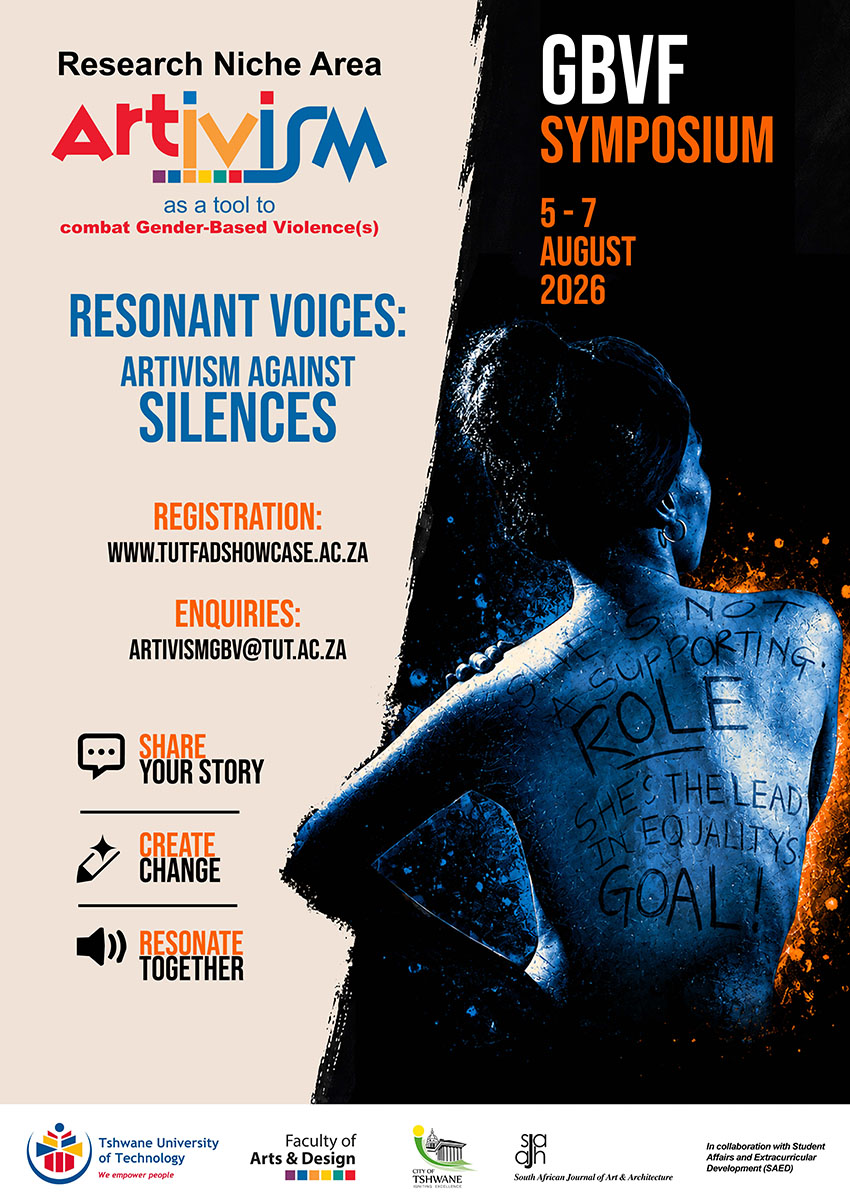
The Tshwane University of Technology will host the 3rd annual Gender-Based Violence and Femicide (GBVF) Symposium from 5 – 7 August 2026, bringing together stakeholders to explore artivism as a catalyst for social change.
Co-hosted by the Faculty of Arts and Design's Research Niche Area: Artivism as a Tool to Combat Gender-Based Violence(s), alongside the Division of Student Affairs and Extracurricular Development (SAED), the South African Journal of Art History (SAJAH) and the City of Tshwane (CoT), the symposium will take place at TUT's Arts Campus and the Breytenbach Theatre.
The theme of this year's event is Resonant Voices. Artivism Against Silence. In recognition of the urgency and importance of addressing GBVF within the context of higher education, this dynamic gathering will bring together scholars, artivists, researchers and practitioners to explore innovative, arts-based approaches to activism, healing and advocacy.
The three-day symposium will kick-off with a student directed programme. This will highlight the role of SAED in higher education through artivism and social transformation.
Additionally, the following will be discussed:
- The role of Health and Wellness in providing psycho-social support to victims of GBVF
- Student Development and Support (SDS) will focus on the GBVF Gender Desk, motivation beyond awareness and healing processes.
- Student Governance and Leadership Development (SGLD) will address the barriers to reporting GBVF on campus.
- The Institutional Student Representative Council (ISRC) leaders will amplify student voices to raise awareness.
- Accommodation, Residence Life and Catering (ARLC) will address the challenges of creating and maintaining safe residences.
- Sports and Recreation (S&R) will explore, through dialogue, the pathways to creating sustainable interventions that go beyond mere awareness-raising campaigns.
- The Department of Extracurricular Development (DED)'s registered students will present thematically focused musicals, poetry and drama performances.
The aim is to advocate for action plans and to strengthen strategies that go beyond awareness-raising campaigns, including GBVF curricula in higher education.
This year, we will have our first theatrical keynote performance, Remnants.
What remains in the aftermath of Gender-Based Violence? Remnants is a new dance theatre work created for the 2026 GBVF Symposium by Dr Nicola Haskins, Tshwane University of Technology, and Prof Marié-Heleen Coetzee, University of Pretoria.
Using text and movement, the work enters the silence between what is seen and what is done, asking how the aftermath of violence continues to be felt and witnessed. Developed through a collaboration between TUT and UP, Remnants brings dance and drama students into a shared performance process that positions theatre as a space for testimony, critical reflection and collective accountability.
The focus of the second day will shift to the economic cost of GBVF on societies. Prof Rasigan Maharajh, Professor of Public Affairs in the Faculty of Humanities at TUT, an elected member of the Academy of Science of South Africa and an Associate Research Fellow at the Tellus Institute, will deliver the keynote address on 7 August.
This year’s symposium will provide a platform for multi-vocal perspectives on GBVF, recognising the diversity of experience and approaches necessary to confront this complex issue. We aim to create a space for rich interdisciplinary dialogue where academic research, creative practice and lived experience intersect to generate actionable strategies for change.
For more information, please visit www.tutfadshowcase.ac.za or email ArtivismGBV@tut.ac.za