TUT students apply classroom knowledge to practical on-site construction trade skills
Academics
13 March 2026
By Mosima Rafapa
A group of 117 Building Sciences students from TUT recently participated in a three-day practical training camp designed to expose them to the realities of the construction trade environment.
 Hosted by Africa International Training Facilities, an accredited Training Centre and Trade Test Centre based in Johannesburg, the inaugural annual camp gave second-year students from the Faculty of Engineering and the Built Environment (FEBE) at the Tshwane University of Technology (TUT) an opportunity to gain hands-on experience in essential trade skills that underpin professions in the built environment.
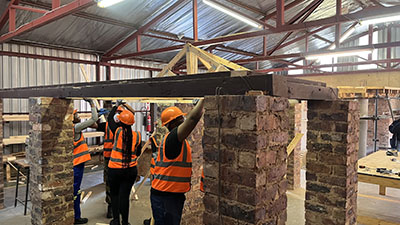
During the programme, students rotated through a range of trade disciplines, allowing them to experience the practical aspects of construction that support infrastructure and development projects. From mastering the basics of plastering to understanding the precision required in plumbing, students explored carpentry techniques and engaged with the fundamentals of electrical work.
They also learnt how to wire a plug as part of electrical trade training, mixed cement, laid bricks and, in some cases, even repaired doors. Rather than simply observing demonstrations, the students actively participated in these tasks, experiencing first-hand the technical demands and craftsmanship involved in the trade sector.
 According to Quantity Surveying lecturer, Bogolo Ntombela, the camp was an eyeopener for student in terms of entrepreneurial opportunities available in the construction industry. It also bridged the gap between theory and practice by exposing them to real trade environments early in their academic journey.
“Not only are we creating well-rounded Quantity Surveyors and Construction Managers, but also entrepreneurs who can make a meaningful contribution within the industry. This especially aligns with the University's strategy that aims beyond graduates becoming professionals and taps into the vast world of entrepreneurship,” said Ntombela.
She added that the three-day camp is part of FEBE’s broader initiative to provide students with both theoretical knowledge and practical skills, preparing them for the demands of the built environment industry and enabling them to recognise the important role trades play in construction and infrastructure development.
“The students had the opportunity to move beyond the classroom and experience real trade environments. They engaged directly with practical tasks, asked questions and observed how theoretical knowledge is applied in real-world settings,” she added.
For many students, the camp was both eye-opening and inspiring.
Second-year Building Sciences student, Kgaugelo Mokgalaka, said the experience helped them understand the importance of practical skills within the built environment.
“It was incredible. Being able to work with the tools and see how things are done in real life was phenominal. It helped me understand how the theory we learn in class connects to what actually happens on site,” the student said.
Kefilwe Ngqoko added that the hands-on training provided valuable insight into the different trades that contribute to construction projects.
“My experience at the camp was outstanding because it allowed me to apply theoretical concepts in a practical way. It also highlighted the importance of teamwork in our industry. I enjoyed learning how to mix cement and lay bricks. It was challenging at first, but it gave me a new appreciation for the skills that go into building structures.”
Caption: Building Sciences students from FEBE participated in a three-day practical training camp, gaining hands-on experience in essential construction trade skills.
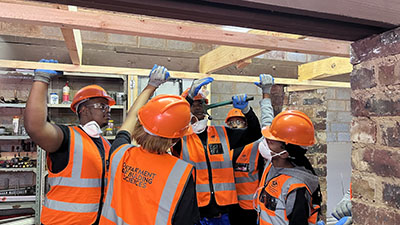
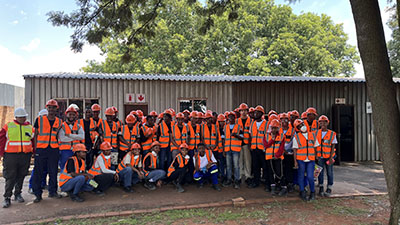
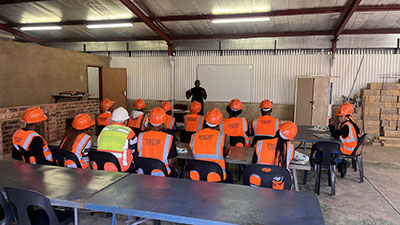
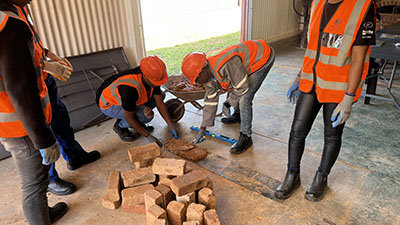
Building Sciences students from FEBE participated in a three-day practical training camp, gaining hands-on experience in essential construction trade skills.