TUT strengthens fight against malaria through Mathematical modelling
Academics
24 April 2026
As South Africa prepares to observe World Malaria Day on 25 April 2026, the urgency of this year’s theme, “Driven to End Malaria: Now We Can. Now We Must,” is underscored by a concerning rise in malaria cases in Gauteng. According to the Gauteng Department of Health, recent surveillance data shows a sharp increase in both infections and fatalities, highlighting the growing public health risk and the need for strengthened prevention, early detection and coordinated intervention strategies.
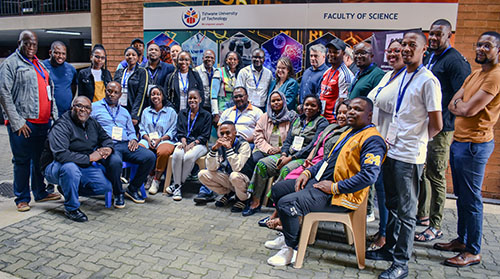 Driving solutions through science: Delegates at the AMMnet launch at TUT, working together to combat malaria through mathematical modelling and interdisciplinary research.
Between January and March 2026, Gauteng recorded 414 confirmed malaria cases and 11 deaths. This represents a significant increase compared to the same period in 2025, when 230 cases and just one death were reported. In total, 666 cases and seven deaths were recorded across the whole of 2025. The increase is largely linked to travel patterns, particularly during the festive season, when many residents visit malaria-endemic regions such as Limpopo, Mpumalanga, Mozambique, KwaZulu-Natal, Zimbabwe, and Malawi, returning with increased exposure to infection. Health authorities continue to urge residents to remain vigilant, to recognise symptoms such as fever, chills, headache, and fatigue, and to seek immediate medical attention if symptoms develop. Preventive measures, including the use of insect repellent and protective clothing, remain essential in reducing risk.
Driving solutions through science: Delegates at the AMMnet launch at TUT, working together to combat malaria through mathematical modelling and interdisciplinary research.
Between January and March 2026, Gauteng recorded 414 confirmed malaria cases and 11 deaths. This represents a significant increase compared to the same period in 2025, when 230 cases and just one death were reported. In total, 666 cases and seven deaths were recorded across the whole of 2025. The increase is largely linked to travel patterns, particularly during the festive season, when many residents visit malaria-endemic regions such as Limpopo, Mpumalanga, Mozambique, KwaZulu-Natal, Zimbabwe, and Malawi, returning with increased exposure to infection. Health authorities continue to urge residents to remain vigilant, to recognise symptoms such as fever, chills, headache, and fatigue, and to seek immediate medical attention if symptoms develop. Preventive measures, including the use of insect repellent and protective clothing, remain essential in reducing risk.
Amid this growing concern, the Tshwane University of Technology (TUT), through its Faculty of Science, is playing an increasingly important role in strengthening the national response to malaria. In March 2026, the Department of Mathematics and Statistics, Arcadia Campus, hosted the launch of the South African chapter of the Applied Malaria Modelling Network (AMMnet), formally establishing a local platform dedicated to advancing malaria intervention strategies through mathematical modelling.
The Applied Malaria Modelling Network is a professional association focused on malaria data analytics and modelling, particularly in addressing practical, real-world challenges. The launch event brought together 30 participants from universities, research institutions and the National Department of Health, with strong representation from malaria-endemic provinces including Limpopo, Mpumalanga and KwaZulu-Natal. The initiative has created a collaborative space where students, early-career researchers, academic experts and public health stakeholders can work together to strengthen the understanding and application of modelling in malaria control.
According to Prof Seithuti Moshokoa, Head of the Department of Mathematics and Statistics at TUT, mathematical modelling has become a critical tool for understanding malaria transmission, evaluating the effectiveness of interventions and guiding the allocation of limited healthcare resources. Despite its importance, collaboration between modellers, data scientists and public health implementers in South Africa has historically been limited, particularly within national health structures. The establishment of the AMMnet local chapter directly addresses this gap by fostering stronger connections between research and implementation, ultimately supporting more informed and effective public health responses.
This initiative aligns closely with TUT’s Institutional Strategic Plan (ISP) 2026–2035 and its vision of “Entrepreneuring the Future.” By focusing on research that has direct societal impact, the university is demonstrating how academic innovation can respond to real-world challenges. The AMMnet chapter reflects a commitment to interdisciplinary collaboration, bringing together expertise in mathematics, data science and health sciences to develop practical solutions. It also supports capacity building by equipping students and emerging researchers with the skills needed to contribute meaningfully to national and global health priorities, while strengthening partnerships between academia, government and the broader community.
As World Malaria Day approaches, the convergence of rising case numbers and strengthened scientific collaboration serves as both a warning and a call to action. While the increase in infections in Gauteng highlights the ongoing threat posed by malaria, initiatives such as the AMMnet launch at TUT demonstrate that meaningful progress is possible when knowledge, data and collaboration are brought together. Through continued vigilance at community level and sustained innovation within the scientific community, the goal of a malaria-free future becomes not only aspirational, but achievable.