TUT co-hosts global conference on green and sustainable development
Academics
13 March 2026
By Reatlegile Ratlagane
TUT, North-West University, University of Fort Hare, University of Kigali and KCA University, Kenya, co-hosted the 2nd International Conference on Green and Sustainable Development (ICGSD) in March.
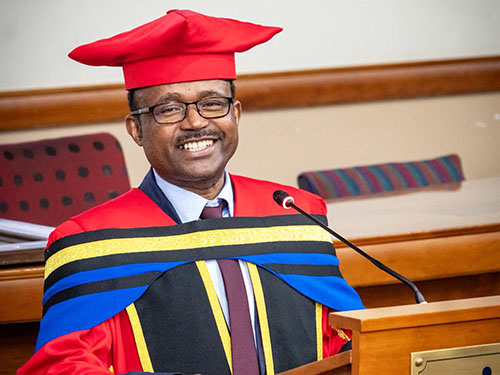 Department of Economics Head, Professor Zerihun.
Global conferences on green and sustainable development, like the 2026 International Conference on Green and Sustainable Development (ICGSD), are crucial platforms that connect policymakers, researchers, industry leaders and innovators to address climate risks and foster international, cross-sectoral collaboration, while also transforming sustainability goals into actionable policies and practical solutions.
Department of Economics Head, Professor Zerihun.
Global conferences on green and sustainable development, like the 2026 International Conference on Green and Sustainable Development (ICGSD), are crucial platforms that connect policymakers, researchers, industry leaders and innovators to address climate risks and foster international, cross-sectoral collaboration, while also transforming sustainability goals into actionable policies and practical solutions.
Aligned with the United Nations Sustainable Development Goals (SDGs) and the African Union’s Agenda 2063, the conference looked at a more just, resilient and regenerative world, driven by African innovation and global cooperation.
Themed Reimagining innovation pathways for sustainability: research, practice and policy, delegates at the three-day ICGSD unpacked several topics through presentations and panel discussions. Speakers explored entrepreneurship, artificial intelligence (AI), collaboration, business growth and environmental change, while panel discussions looked at ways in which innovative policies, emerging technologies and strong global partnerships can drive sustainable business growth, while addressing environmental challenges.
Representative from two departments Auditing Accounting Economics Finance and Investment and Public Sector Finance, that contribute significantly to the Faculty of Economics and Finance’s inputs to research, policy, dialogue and capacity building aimed at promoting responsible governance inclusive economic growth and sustainable financial systems, attended the conference.
 Co-host of the conference,Dr Sindi Mokgopha.
Sindi Mokgopha, lecturer from TUT’s Department of Public Sector Finance and co-organiser of the conference, explained how researchers collaborate to promote sustainable development through technology.
Co-host of the conference,Dr Sindi Mokgopha.
Sindi Mokgopha, lecturer from TUT’s Department of Public Sector Finance and co-organiser of the conference, explained how researchers collaborate to promote sustainable development through technology.
“In my view, our mistake as academics is discussing issues that affect the community in their absence. Because of this, I wrote a paper that questions if ordinary citizens understand what green sustainability is, discovering that many people in fact, do not know,” she said.
She stressed the need to educate communities about green sustainability and the importance of not contributing to environmental harm. She also acknowledged Rwanda for its cleanliness, noting that South Africa can learn from them and adopt similar practices.
Delivering the keynote address, Sindiswa Mzamo, G20 Co-Chair and President of the Circle of Global Business Women, highlighted areas that promote women leadership in sustainable development across Africa. These include creating networking opportunities for women leaders and addressing systemic barriers, stereotypes and cultural norms that limit women leadership.
Prof Mulatu Zerihun, Head of TUT’s Department of Economics, emphasised the importance of strong collaboration between government, universities and industry. He said TUT strengthened Work-Integrated Learning in its curriculum to integrate academic learning with industry and community engagement.
“After 2020, TUT completely changed its curriculum to implement compulsory work integrated learning. We are bringing the component of industry and community together in our curriculum. This gives the University an opportunity to contribute to industry and the community,” he said.
He also highlighted the Artificial Intelligence Institute of South Africa-supported AI Hub at TUT, which promotes innovation and skills development in emerging technologies.
Prof Zerihun continued to highlight the role the Faculty of Information and Communication Technology plays in green and sustainable development, while preparing future-ready students for the world of work. “At TUT, our ICT Faculty partners with industry bodies and offers structured training that equips students and young professionals with practical drone piloting skills and certification. These programmes focus on areas such as precision agriculture aerial monitoring and safe drone operation,” he said.
He added that the Faculty of Economics and Finance research niche area, Inclusive Growth Socioeconomic Development and Transformation, together with the UNESCO Chair in African Integration and Innovation, continues to drive research and dialogue on sustainable development and regional integration across Africa.
 Attendees at the Green and Sustainable Conference in Stellenbosch, Cape Town.