The Girls in Tech programme inspires young innovators through a hackathon
Academics
26 October 2026
By Thembeka Manetje and Tshegofatso Letsoalo
The Tshwane University of Technology’s (TUT) Faculty of Information and Communication Technology (ICT) is helping young girls across South Africa discover their potential in science, technology, engineering and mathematics (STEM) through a collaborative hackathon initiative that introduced members of Girl Guides South Africa (GGSA) to artificial intelligence (AI), digital innovation, and technology-driven problem solving.
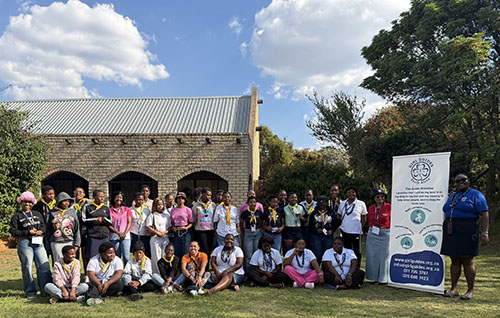 Girls in Tech with learners from Girl Guides South Africa.
Held in collaboration with GGSA and the faculty’s Girls in Tech (GiT) empowerment programme, the initiative brought together 29 rangers and youth members of GGSA, many of whom were experiencing a hackathon for the first time. Guided by the theme “Guiding Girls Towards a Confident Future Through Innovation, Artificial Intelligence, and Digital Technology,” the programme aimed to build digital skills, strengthen confidence and encourage young women to see themselves as future innovators and technology leaders.
The initiative was supported by a series of three preparatory workshops designed to equip participants with the knowledge and practical skills needed to develop solutions to real world challenges. These sessions introduced the girls to concepts that extended beyond technology, encouraging them to understand problems, consider the needs of users and develop innovative solutions with meaningful social impact.
During the first workshop, facilitated by Matthews Mfati, participants explored design thinking, empathy mapping and the development of user personas.
The second workshop, facilitated by Dr Diana Pholo, focused on transforming identified problems into AI system blueprints. Participants were introduced to the fundamentals of coding and data, the differences between rule-based and AI systems, and the importance of ethical technology development.
The third workshop, facilitated by Matthews Mfati and Thembelihle Mncube, introduced participants to Voice over Internet Protocol (VoIP), smart communication systems, user interface and user experience (UI/UX) design, wireframing and rapid prototyping using Figma and Canva. The girls also explored business innovation, the Business Model Canvas, and pitch deck development, equipping them with tools to communicate their ideas and demonstrate the potential impact of their solutions.
During the hackathon, participants applied their newly acquired knowledge while incorporating GGSA’s core advocacy programmes, Surf-Smart, which promotes online safety, and Free Being Me, which focuses on self-esteem and positive body confidence. This integration encouraged the girls to consider how digital innovation could address issues affecting their own lives and communities.
Mentorship from the Girls in Tech programme played an important role throughout the hackathon. The mentors supported participants in refining their ideas, developing prototypes and preparing their presentations. Following their initial pitches, the teams used feedback from the adjudicators to refine their concepts and strengthen their proposed solutions for the second-round presentations.
For many of the girls, the experience represented a significant step towards recognising their potential in technology. Being introduced to concepts such as AI, coding, prototyping and business innovation helped them develop confidence in their ability to engage with technical challenges. Their participation also strengthened their interest in STEM and opened new possibilities for further learning and development.
On behalf of GGSA, Bekwa Mdakane, programmes manager, responsible for the education programme, expressed her appreciation for the faculty’s contribution, highlighting the value of the preparatory workshops and the confidence the participants gained through the collaboration.
The partnership demonstrates the value of collaboration between higher education institutions and youth organisations in expanding access to digital learning and innovation. It also highlights the importance of creating inclusive environments where young girls can develop practical skills, express their ideas and build the confidence to participate in a rapidly evolving digital world.