Teacher education reimagined for the AI era
Academics
19 November 2026
By Reagile Frances Makwela and Mpho Queen Murabi
South Africa’s teacher-education sector is preparing for a significant shift as artificial intelligence (AI) continues to reshape teaching, learning, assessment and academic integrity.
 The Department of Higher Education and Training (DHET) plans to introduce a revised Minimum Requirements for Teacher Education Qualifications (MRTEQ) policy in 2027, aligned with the updated Higher Education Qualifications Sub-Framework (HEQSF). The revised policy is expected to incorporate emerging technologies into national teacher-training standards.
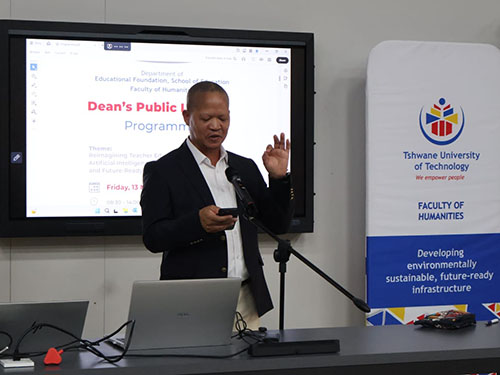
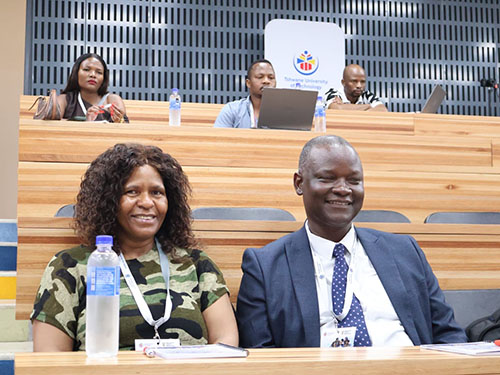
This development took centre stage at the Tshwane University of Technology (TUT) Faculty of Humanities Dean’s Public Lecture, held at the Soshanguve North Campus on 13 November 2026. Hosted by the Department of Educational Foundation in the School of Education, the lecture brought together policymakers, academics, researchers, students and education-technology representatives under the theme, Reimagining Teacher Education in the Era of Artificial Intelligence: Preparing Ethical, Innovative and Future-Ready Educators.
Opening the programme, School of Education Assistant Dean Dr Jeanette Khabonina Ramollo challenged higher education institutions to move beyond asking whether AI would change teacher education and instead consider who would shape and direct that change.
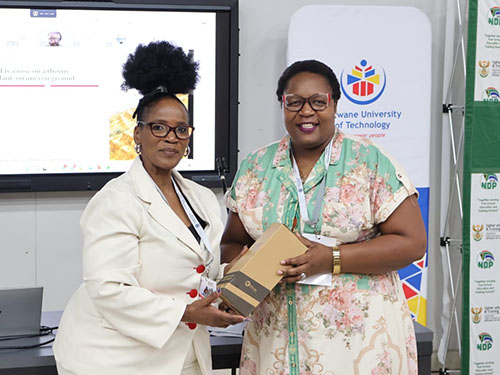 She stressed that while AI could generate text within seconds, educators remained responsible for developing critical thinking, inspiring learners and ensuring that technology was used responsibly and in accordance with sound institutional policies.
Executive Dean of the Faculty of Humanities, Prof Mashupye Maserumule said the lecture reflected TUT’s commitment to bringing universities, government and industry together to address practical challenges facing education.
He proposed three guiding principles for the sector: responsibility, ensuring that technology supports rather than replaces teachers; ethics, protecting academic integrity and human dignity; and inclusion, using digital tools to help narrow inequalities between well-resourced and rural schools.
 Dr Justinus Rankgakgata Setshedi, Deputy Director for Pre- and School Teacher Education at DHET, highlighted the policy implications of AI and said teacher-training institutions must adapt without losing the human dimension of education.
He cautioned that access to polished AI-generated text did not necessarily demonstrate genuine understanding and could make it increasingly difficult for lecturers to assess students’ work fairly. He called for greater attention to information literacy, data privacy and rural connectivity as emerging technologies are integrated into teacher-education programmes.
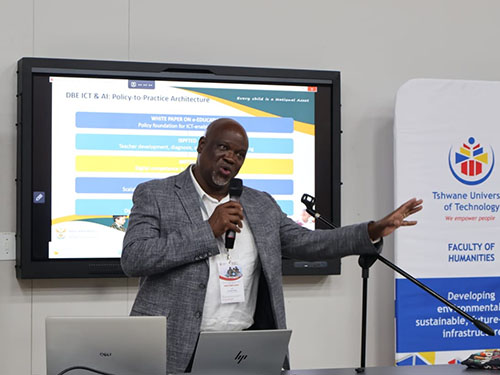
Dr Aaron Nkosi, Acting Chief Director for Curriculum and Professional Development at the Department of Basic Education, said information and communication technology and AI should be regarded as practical teaching tools rather than additional subjects disconnected from classroom practice.
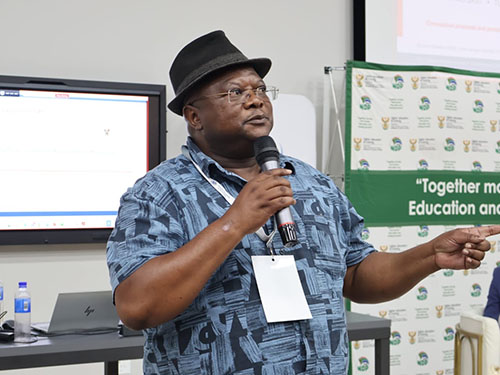 He cautioned that distributing devices and recording attendance at training workshops were not sufficient measures of success. Instead, technology initiatives should be evaluated by whether educators gained confidence in the classroom and whether they contributed to improved learner outcomes.
Dr Nkosi added that universities should strengthen critical and scientific thinking among student teachers because AI could only support meaningful learning when combined with teacher expertise, effective pedagogy and active student participation.
Ms Keneilwe Molotsi, an Instructional Designer in TUT’s Department of Learning Experience Design, part-time lecturer and doctoral student, urged African universities to develop AI solutions responsive to local educational realities rather than relying exclusively on models developed elsewhere.
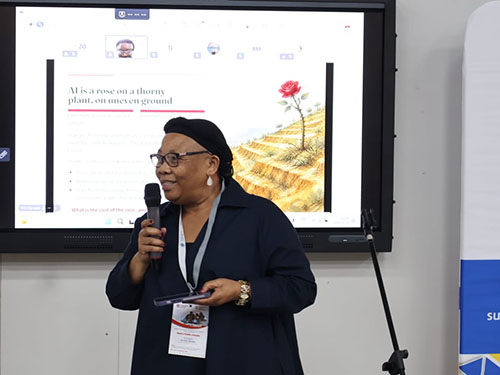 She stressed that the availability of digital platforms did not automatically translate into effective teaching, particularly where emerging technologies were absent from study guides and online student engagement remained limited. “When students submit AI-generated work, where is their own voice?” Molotsi asked. She called on lecturers, institutional leaders and students to develop ethical AI practices that also acknowledge unequal access to laptops, connectivity and mobile data.
Joining the lecture virtually from Finland, Dr Päivi Aarreniemi-Jokipelto, Principal Lecturer in Digital Pedagogy and Head of the Digital Pedagogy Research Group at the Haaga-Helia School of Professional Teacher Education, encouraged educators not to adopt a defensive approach to AI. She said universities should examine how tools such as ChatGPT were changing classroom relationships, coursework and examinations. A human-centred approach, she argued, would allow educators to remain in control of learning, assessment and feedback.
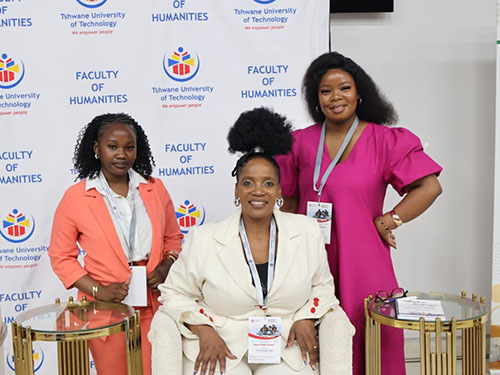 She also encouraged universities to reconsider traditional written assignments in the age of AI, suggesting that assessment should place greater emphasis on the learning process rather than solely on the final product.
During a question-and-answer session facilitated by Prof Sibongile Mnisi, participants reinforced the need for lecturers to assess the processes behind AI-assisted assignments. They also called for teacher educators to be included in professional-development programmes offered by the Department of Basic Education.
Participants further raised questions about how teachers were using AI in practice and highlighted the need for clear boundaries within the Curriculum and Assessment Policy Statement (CAPS). They cautioned against learners becoming dependent on AI at the expense of developing independent reasoning and critical-thinking skills. The discussions repeatedly returned to the relationship between AI adoption and access to basic digital infrastructure.
Industry exhibitors, including ITWise, Snapplify, The Virtual Space, Futurekids and TriTalkAssist, enriched the lecture by showcasing technologies designed to support teaching and learning. Their participation also created opportunities to strengthen industry-academia collaboration and foster partnerships around educational innovation.
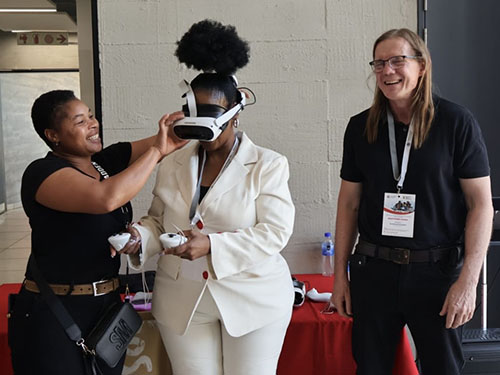 The technologies demonstrated included solutions for offline learning, communication support for the Deaf community, e-resources and e-books, virtual, augmented and mixed reality, coding and robotics, shared computing and access to approved curriculum resources.
Bethy Lucia of ITWise said schools first needed to ensure that learners were confident computer users before expecting them to engage meaningfully with AI. “Before we can fully embrace AI, we need to ensure that every learner has the opportunity to learn basic computer skills and understand how to use a computer,” she said.
Dr Vusi Joseph Maseko, National Digital and Online Learning Expert in DHET’s TVET, ICT and Curriculum Support Team, presented Thabo, an AI teaching-practice companion designed to support guided professional formation. The tool is intended to enhance the work of teaching-practice mentors while preserving human-centred AI principles, professional agency, ethical use and digital competencies.
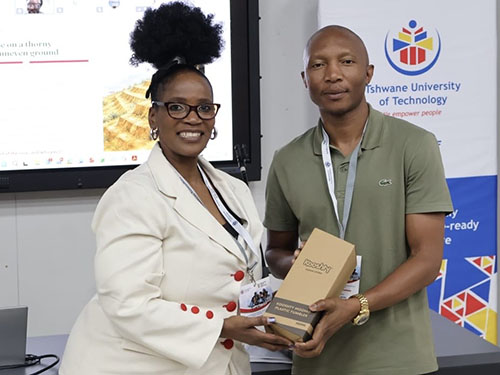 Addressing the balance between technological innovation and teachers’ professional responsibilities, Prof Princess Blose, Acting Chair of the Department of Science and Technology Education at the University of South Africa, warned against preparing educators who relied on AI as a substitute for reflection, pedagogical knowledge and problem-solving. Although AI could produce lesson plans within seconds, she said it could not replicate the human connection at the centre of meaningful education. “Use AI, but always remember your responsibility and mandate: developing the learner,” Prof Blose said.
Prof Reuben Dlamini from the University of the Witwatersrand School of Education argued that reimagining teacher education should extend beyond simply preparing teachers to use AI. Rather, teacher education should equip educators to shape inclusive, equitable and socially just AI-enabled futures. Drawing on human-centred AI, multiliteracies and contextualised African perspectives, he advocated a shift from technology consumption towards innovation, co-design and sustainable educational transformation.
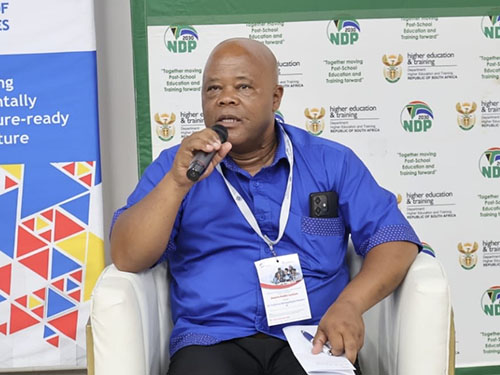 Joining virtually from Cape Town, Prof Dick Ng’ambi, Programme Head for postgraduate studies in Educational Technology at the University of Cape Town’s School of Education, used the metaphor of a rose growing on a thorny plant across uneven ground to illustrate both the opportunities and challenges presented by AI.
He noted that AI was present in both severely under-resourced and affluent schools. While learners from different socio-economic backgrounds might encounter the same technology, the circumstances in which they accessed and used it differs significantly. These inequalities, he argued, must inform how AI is introduced and experienced across educational settings.
Prof Ng’ambi said the central challenge was to move beyond technology itself towards genuine transformation, requiring technology, pedagogy, curriculum, leadership and learners to work together. His analogy captured a central message running throughout the lecture: while AI offers considerable opportunities for education, its benefits cannot be separated from the inequalities and ethical challenges surrounding its use.
Across the discussions, speakers agreed that AI should strengthen, rather than replace, teachers’ professional judgement and human connection.