Student innovators turn city challenges into smart solutions at Tshwane Varsity Hackathon
Academics
10 November 2026
By Kgothatso Monono
From detecting potholes before they damage vehicles to identifying infrastructure failures before they disrupt communities, student innovators are harnessing technology to rethink how cities respond to everyday challenges. This spirit of innovation took centre stage at the eighth annual Tshwane Varsity Hackathon (TVH), where Team IntelliResponse emerged as the 2026 winner with an innovative predictive infrastructure-monitoring solution for the City of Tshwane.
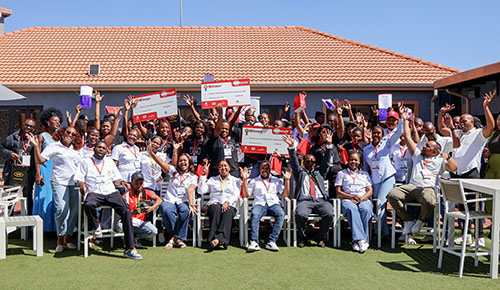
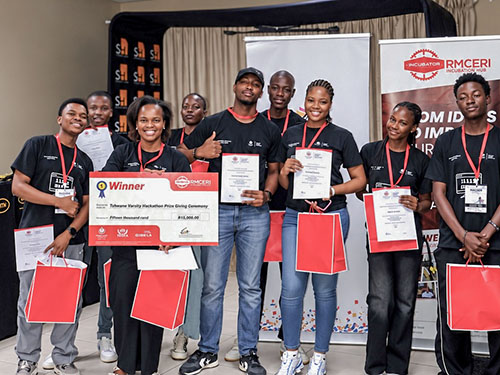 Hosted by the Tshwane University of Technology’s (TUT) Faculty of Information and Communication Technology (ICT) at the Ga-Rankuwa Campus, in collaboration with the City of Tshwane, the hackathon brought together students from universities across Tshwane to develop practical, technology-driven solutions to real-world municipal challenges.
The competition encouraged participants to move beyond conventional approaches to problem-solving and explore how emerging technologies could enhance service delivery, infrastructure management and the quality of life in communities.
Taking top honours, Team IntelliResponse impressed with a proposed predictive infrastructure-monitoring system designed to help the City detect, monitor and address infrastructure problems before they escalate into major failures.
At the heart of their innovation is an integrated system combining vehicle sensors, dashboard cameras and citizen-generated reports to monitor the condition of municipal infrastructure. The team proposes installing sensors in vehicles already operating across the city, including refuse trucks, Tshwane Metro Police Department (TMPD) vehicles and South African Police Service (SAPS) vehicles.
As these vehicles travel along municipal roads, sensors would detect unusual vibrations in their suspension systems that could indicate potholes and road irregularities. GPS technology would then pinpoint the location of the detected defects. A key strength of the proposal is its ability to leverage vehicles already travelling across the city. Rather than requiring an additional monitoring fleet, municipal and law-enforcement vehicles could effectively become mobile infrastructure-monitoring units, gathering valuable data during their routine operations.
 Dashboard cameras would complement the sensors by providing visual evidence of detected road conditions, enabling the municipality to verify and assess reported problems. Recognising that municipal vehicles cannot reach every location, the team’s solution also places residents at the heart of the monitoring process. Citizens would be able to submit photographs of infrastructure problems, including burst water pipes, malfunctioning traffic lights, faulty streetlights and drainage systems obstructed by litter. This citizen-driven component would extend monitoring into areas that municipal vehicles may not easily access.
By integrating information from multiple sources, the proposed system would analyse infrastructure conditions, identify signs of deterioration, anticipate potential failures and prioritise high-risk assets requiring attention. The approach could help shift municipal maintenance from a largely reactive model towards a proactive, data-driven system. Instead of waiting for infrastructure to deteriorate or fail before responding, the City could identify problems earlier, plan maintenance interventions more effectively and potentially reduce repair costs.
Team IntelliResponse comprises Reatlegile Malapane, Cynthia Mlambo, Sunday Okeugiri, Walter Monson, Grether Masedi, Andile Nkosi, Tumiso Moloi, Thabang Maila, Loyiso Nkosi and Masaka Malwandla. Nkosi represents Sefako Makgatho Health Sciences University (SMU), while the remaining team members are from TUT.
Beyond recognising outstanding student innovation, the eighth annual hackathon highlighted the value of collaboration between higher education institutions and local government in addressing pressing urban challenges. The partnership between TUT and the City of Tshwane provided students with an opportunity to engage directly with real municipal challenges and explore how their knowledge, creativity and technical skills could be translated into solutions with practical value.
Team IntelliResponse’s winning proposal demonstrates that innovation does not always begin with expensive technologies or complex ideas. Sometimes, it starts by seeing familiar challenges differently and finding smarter ways to address them. By connecting student talent, technological innovation and municipal priorities, the Tshwane Varsity Hackathon continues to demonstrate the potential of collaborative partnerships to contribute towards a smarter, more responsive City of Tshwane.