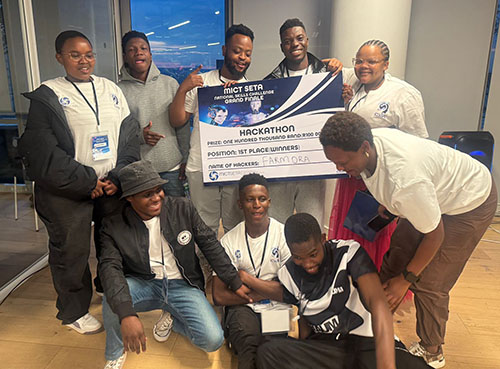
Smart agriculture breakthrough earns national recognition for Farmora innovators
AcademicsOther
22 April 2026
By Kgothatso Monono
Before graduating from the Faculty of ICT at the Tshwane University of Technology, Joe Junior Mabatha and Kulani Shaun Mabasa were part of a seven-member multidisciplinary team that achieved national recognition at the MICTSETA National Skills Challenge Hackathon. The team, drawn from different institutions across South Africa, collaborated to develop an award-winning smart agriculture solution that reflects the power of cross-institutional innovation and teamwork.
 Kulani Shaun Mabasa
Together, the team comprising Kabelo Nkoane from TUT, Kgetja Bruce Mphekgwane from Wits, Masibonge Shabalala from UJ, Lunga Ntshingila from TUT, Joe Junior Mabatha from TUT, Kulani Shaun Mabasa from TUT and Matshepo Soto from We Think Code, built Farmora, an intelligent smart farming platform designed to address critical challenges in agriculture.
Kulani Shaun Mabasa
Together, the team comprising Kabelo Nkoane from TUT, Kgetja Bruce Mphekgwane from Wits, Masibonge Shabalala from UJ, Lunga Ntshingila from TUT, Joe Junior Mabatha from TUT, Kulani Shaun Mabasa from TUT and Matshepo Soto from We Think Code, built Farmora, an intelligent smart farming platform designed to address critical challenges in agriculture.
The Farmora solution uses Internet of Things (IoT) sensors, artificial intelligence (AI), and cloud computing to help farmers monitor real-time environmental conditions, including soil moisture, temperature and humidity. By converting this data into actionable insights, Farmora enables farmers to make informed decisions that improve productivity, reduce waste and strengthen food security.
The team selected the AgriTech and Food Security domain due to its importance in the South African context. Agriculture remains a key driver of both economic development and food supply, yet many small-scale farmers still lack access to reliable data, advisory systems, and market opportunities. Farmora was designed to bridge this gap by providing a unified, accessible and data-driven farming support system.
What makes Farmora particularly innovative is its integrated design approach. Instead of focusing on a single function, the platform combines multiple capabilities into one system: real-time IoT monitoring, AI-powered recommendations, multilingual voice-enabled chatbot support and a QR-based traceability feature that enhances transparency and trust in agricultural supply chains. This end-to-end solution gives farmers a single platform to monitor conditions, receive guidance and prove the quality of their produce.
The solution’s impact extends beyond individual farmers. By improving productivity and reducing losses, Farmora supports rural economic growth, enhances food security and builds stronger trust between producers and consumers. It is designed with scalability in mind, with potential for deployment across different regions through localised agricultural data and partnerships with government and agricultural organisations.
 Joe Junior Mabatha
Technically, the team successfully integrated all required hackathon technologies. ESP32 microcontrollers and sensors were used to collect real-time environmental data, while edge computing enabled efficient on-device processing. AI systems provided intelligent, context-aware farming recommendations and a user-friendly interface supported data visualisation and accessibility. The team also developed a 3D-printed prototype housing to demonstrate real-world applicability and durability.
Joe Junior Mabatha
Technically, the team successfully integrated all required hackathon technologies. ESP32 microcontrollers and sensors were used to collect real-time environmental data, while edge computing enabled efficient on-device processing. AI systems provided intelligent, context-aware farming recommendations and a user-friendly interface supported data visualisation and accessibility. The team also developed a 3D-printed prototype housing to demonstrate real-world applicability and durability.
Clearly defined roles aligned with individual strengths drove the project’s success. Kulani led the hardware and IoT integration, contributing both software and self-taught hardware engineering expertise. Joe served as Scrum Master, supporting coordination, task management and system integration across the team. Other members contributed to backend development, frontend design, AI components, and overall system architecture, ensuring a fully integrated solution.
Following this national hackathon victory, Joe (Informatics) and Kulani (Computer Science-CUMLAUDE) completed their studies and graduated from the Faculty of ICT. Their participation in the competition served as a practical extension of their academic journey, allowing them to apply theoretical knowledge in a high-pressure, real-world innovation environment before formally completing their qualifications.
The experience reinforced the value of teamwork, interdisciplinary collaboration and applied learning. It also highlighted how innovation challenges, such as the MICTSETA hackathon, can bridge the gap between academic training and industry readiness.
Reflecting on the journey, the team encourages students to actively participate in innovation challenges, emphasising that hackathons are not only about competition but also about learning, collaboration and building solutions to real-world problems.