Researchers explore AI, economic resilience and Africa’s growth at UNESCO Chair Seminar
Academics
24 August 2026
By Reatlegile Ratlagane
From artificial intelligence in academic publishing to economic resilience and export diversification, researchers from the African continent gathered at the Tshwane University of Technology’s (TUT) UNESCO Chair on African Integration and Innovation Research Seminar.
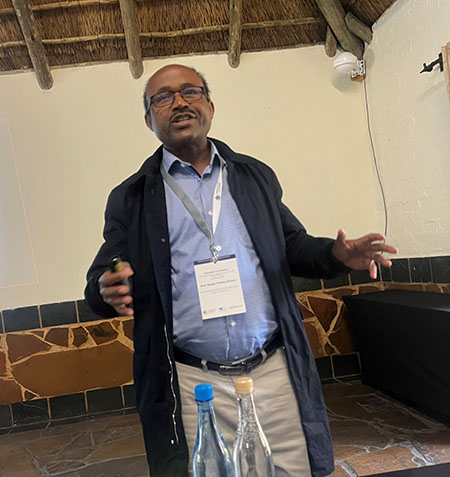 The HoD for the Department of Economics, Professor Mulatu Zerihun, presenting his research paper.
Hosted by the Department of Economics, the seminar aimed to strengthen research knowledge, exchange ideas, present findings and explore publication opportunities while identifying solutions to challenges shaping Africa’s economy and future development.
The HoD for the Department of Economics, Professor Mulatu Zerihun, presenting his research paper.
Hosted by the Department of Economics, the seminar aimed to strengthen research knowledge, exchange ideas, present findings and explore publication opportunities while identifying solutions to challenges shaping Africa’s economy and future development.
Prof Mulatu Zerihun, NRF C2-rated researcher, UNESCO Chair and Head of the Department of Economics, presented a paper titled Alternative Thinking in Economics. He encouraged researchers to embrace diverse perspectives and approaches, emphasising that research benefits from different ways of thinking.
"Diverse thinking strengthens research by encouraging new perspectives and innovative solutions. Research is not a one-size-fits-all endeavour," he said.
Prof Zerihun reflected on Africa’s history and economic development, highlighting the importance of understanding historical contexts when developing solutions to current challenges. He also encouraged researchers to pursue their areas of passion and advance knowledge in economics, a discipline that influences many aspects of everyday life.
Prof Paul-Francois Muzindutsi, an NRF-rated finance expert from the University of KwaZulu-Natal (UKZN), delivered a guest lecture titled Writing for Publication in the Age of Artificial Intelligence (AI). He explored the growing role of AI in research and publication, addressing common challenges researchers face when developing research papers, including methodology, data analysis and writing structure. He also highlighted the importance of using AI ethically and responsibly in academic work.
The seminar also provided an opportunity for the Department of Economics’ postdoctoral fellows to present their research and receive constructive feedback from colleagues.
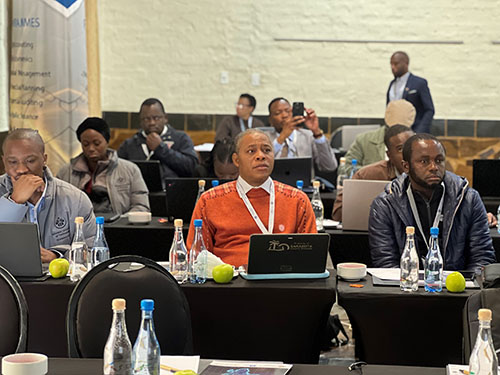 The attendees of the UNESCO Seminar.
Dr Kazeem Isah, expert economist, lecturer, and research fellow. He is ranked among the top 5% of economists in Nigeria and the top 10% in Africa by the Research Papers in Economics (RePEc) Network, presented research examining how climate variability affects various sectors of South Africa’s economy and whether strong Environmental, Social and Governance (ESG) conditions contribute to greater economic resilience.
The attendees of the UNESCO Seminar.
Dr Kazeem Isah, expert economist, lecturer, and research fellow. He is ranked among the top 5% of economists in Nigeria and the top 10% in Africa by the Research Papers in Economics (RePEc) Network, presented research examining how climate variability affects various sectors of South Africa’s economy and whether strong Environmental, Social and Governance (ESG) conditions contribute to greater economic resilience.
Dr Olivier Ogbonna, lecturer in the Department of Economics at the University of Nigeria, Nsukka, presented a study titled Moderating Effects of Exports Diversification on Economic Policy Uncertainty and Exports Nexus in Africa. His research examined how global economic instability, including trade disputes, conflicts and policy uncertainty, influences export performance across the continent.
Dr Oluwatoyin Akinbowale, academic researcher, finance expert and postdoctoral fellow specialising in managerial accounting, finance, and cyberfraud mitigation, shared findings from her study, Evaluating the Loan Default Rate Using Deep Learning AI Techniques, which investigated the use of artificial intelligence to predict loan default patterns.
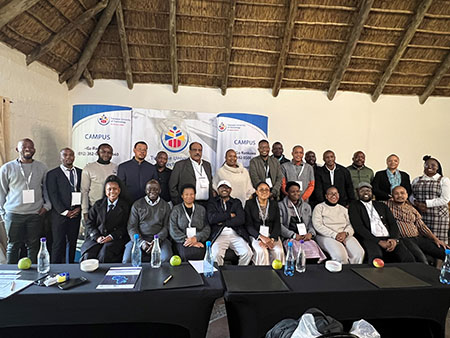 The attendees of the UNESCO Seminar.
The seminar concluded with a learning session facilitated by Dr Mukhethwa Londani, a South African academic researcher, senior biostatistician and Statistical Analyst at TUT, introduced researchers to QuestionPro, an online survey and research platform used to design and distribute questionnaires. He explained that understanding QuestionPro is highly critical because it bridges the gap between raw human sentiment and actionable, data-driven strategy. In both corporate and academic settings, the platform directly impacts how research data is gathered, protected and visualised.
The attendees of the UNESCO Seminar.
The seminar concluded with a learning session facilitated by Dr Mukhethwa Londani, a South African academic researcher, senior biostatistician and Statistical Analyst at TUT, introduced researchers to QuestionPro, an online survey and research platform used to design and distribute questionnaires. He explained that understanding QuestionPro is highly critical because it bridges the gap between raw human sentiment and actionable, data-driven strategy. In both corporate and academic settings, the platform directly impacts how research data is gathered, protected and visualised.
The event reinforced the value of collaboration, knowledge sharing and continuous learning in advancing research that contributes to Africa’s economic development and innovation agenda.
- The UNESCO Chair Research Seminar was supported by a grant from the African Union Development Agency (AUDA-NEPAD).