Research Day showcases innovation in AI, cybersecurity and emerging technologies
Academics
14 October 2026
By Kgothatso Monono
The Faculty of Information and Communication Technology (ICT) at the Tshwane University of Technology (TUT) hosted its 2026 Faculty Research Day, providing a platform for researchers and postgraduate students to showcase research addressing emerging challenges and opportunities in the technology sector.
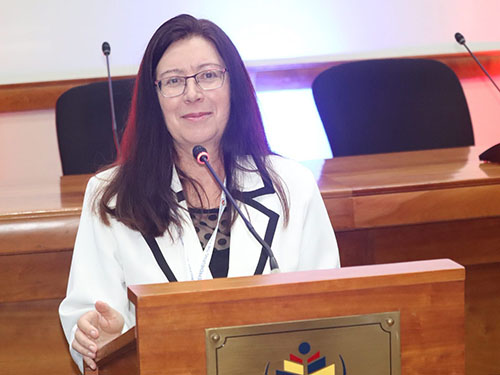 Dr Agnieta Pretorius gave the welcome and opening remarks.
The Research Day brought together researchers and academics to share knowledge and engage with research spanning artificial intelligence (AI), cybersecurity, machine learning, software development, wildlife surveillance, quantum computing and research integrity.
Dr Agnieta Pretorius gave the welcome and opening remarks.
The Research Day brought together researchers and academics to share knowledge and engage with research spanning artificial intelligence (AI), cybersecurity, machine learning, software development, wildlife surveillance, quantum computing and research integrity.
The programme opened with a welcome and opening address by Dr Agnieta Pretorius, Assistant Dean: Postgraduate Studies, Research and Innovation in the Faculty of ICT.
The event’s keynote address was delivered by Dr Willem Thompson, Data Science Delivery Lead and Director at Trizio Consulting. His presentation, titled “Agentic AI in the Workplace: The New Leadership Paradox”, explored the growing role of AI in the workplace and the implications of emerging AI technologies for leadership and organisational practices.
The keynote was followed by a series of oral research presentations showcasing innovative work by researchers in the faculty.
Coster Baloyi presented the research titled “A Hybrid Machine Learning-Based Security Algorithm for Distributed Denial of Service Attacks Detection and Prevention on the Internet of Things.” The research focused on applying machine learning approaches to strengthen the detection and prevention of Distributed Denial of Service (DDoS) attacks in Internet of Things (IoT) environments.
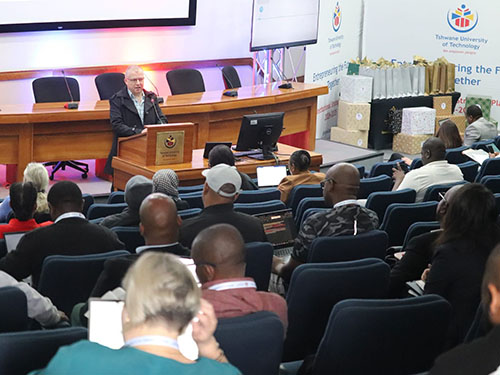 Dr Willem Thompson delivered the keynote address.
Elesa Ntuli presented “Rethinking Curriculum Design in the Era of Generative AI: Towards Contextually Responsive Learning in South African Higher Education.” The research considered the implications of generative AI for curriculum development and the need for higher education institutions to respond to technological changes while ensuring that learning remains relevant to the South African context.
Dr Willem Thompson delivered the keynote address.
Elesa Ntuli presented “Rethinking Curriculum Design in the Era of Generative AI: Towards Contextually Responsive Learning in South African Higher Education.” The research considered the implications of generative AI for curriculum development and the need for higher education institutions to respond to technological changes while ensuring that learning remains relevant to the South African context.
Addressing software development and higher education was Mashitishi Phurutsi, whose research, “A Framework for Adopting a Hackathon for Enhancing Cloud-Native Software Development Competencies in South African Universities,” examined the potential of hackathons as a way of strengthening students’ practical competencies in cloud-native software development.
Kanda Tshinu presented “Edge-Optimised DINOv3-YOLOv8-DeepSORT: A Self-Supervised Approach for Real-Time Cross-Dataset Wildlife Surveillance.” The research explored an AI-based approach to wildlife surveillance, focusing on the use of computer vision and edge optimisation to support real-time monitoring across different datasets.
The Research Day also featured a technical presentation by Dr Vianney Kambale from the Faculty of ICT. His presentation, “Quantum Machine Learning: Promise, Hype, and Open Problems,” examined the opportunities and unresolved challenges surrounding the intersection of quantum computing and machine learning.
Research integrity was another key focus of the programme. Dr Tonderai Muchenje, Senior Lecturer in the Department of Information Technology and Deputy Chair of the TUT Human Research Ethics Committee, delivered an address titled “Responsible Conduct of Research in ICT: Research Integrity, Misconduct and Questionable Research Practices in the Digital Age”.
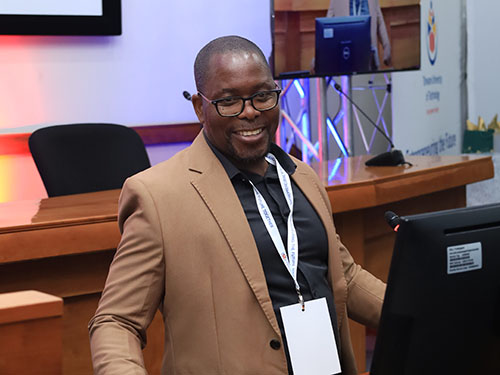 Dr Tonderai Muchenje delivered the research integrity address.
The session highlighted the importance of responsible research practices as technological advances continue to reshape how research is conducted, managed, and shared.
Dr Tonderai Muchenje delivered the research integrity address.
The session highlighted the importance of responsible research practices as technological advances continue to reshape how research is conducted, managed, and shared.
The Research Day further provided postgraduate students with an opportunity to present their research through poster presentations across Master’s and Doctoral, Postgraduate Diploma and National Diploma categories.
The wide range of topics presented during the Research Day demonstrated the faculty’s engagement with research that extends beyond traditional ICT applications, addressing challenges in cybersecurity, education, agriculture, water management, wildlife conservation and digital authentication.
The event also underscored the role of postgraduate research in developing innovative solutions to contemporary challenges and creating opportunities for researchers to exchange ideas and engage with emerging technological developments.