New AI Conversations Chapter fuels collaboration and innovation
Academics
5 August 2026
By Mosima Rafapa
Artificial intelligence is already shaping solutions in healthcare, agriculture, education, transport and wildlife conservation, while the Tshwane University of Technology is creating new opportunities for academics to connect, collaborate and expand that impact. The Faculty of Engineering and the Built Environment’s (FEBE) recently launched TUT AI Conversations Chapter showcased AI-driven projects that are transforming research, teaching and innovation across disciplines.
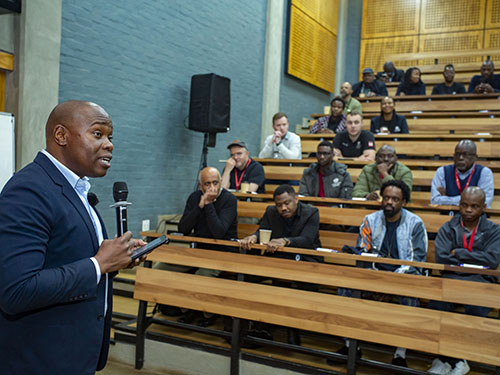 FEBE Executive Dean Prof Mxolisi Shongwe encouraged academics to collaborate, share knowledge and explore AI-driven innovation across disciplines.
During the second edition of its Collaborate & Elevate Coffee Hour, which creates a platform to explore how artificial intelligence (AI) is reshaping teaching, research and innovation, that took place at the Pretoria Campus on 22 July 2026, the TUT AI Conversations - FEBE Chapter was also launched. This initiative is designed to strengthen dialogue, knowledge sharing and interdisciplinary partnerships around AI while supporting the broader work of the TUT AI Hub.
FEBE Executive Dean Prof Mxolisi Shongwe encouraged academics to collaborate, share knowledge and explore AI-driven innovation across disciplines.
During the second edition of its Collaborate & Elevate Coffee Hour, which creates a platform to explore how artificial intelligence (AI) is reshaping teaching, research and innovation, that took place at the Pretoria Campus on 22 July 2026, the TUT AI Conversations - FEBE Chapter was also launched. This initiative is designed to strengthen dialogue, knowledge sharing and interdisciplinary partnerships around AI while supporting the broader work of the TUT AI Hub.
Themed TUT AI Conversations: Exploring AI in Action, the event encouraged participants to exchange ideas, share AI-related projects and identify new opportunities for collaboration.
Prof Mxolisi Shongwe, Executive Dean of FEBE, welcomed attendees and reflected on the vision behind the Collaborate & Elevate initiative. He described it as more than a networking event, saying that it was created to intentionally bring colleagues together to connect, exchange ideas and explore opportunities beyond the boundaries of their disciplines.
"From the start, the vision has been to create a space where colleagues can connect over a cup of coffee, exchange ideas and engage in meaningful conversations across disciplines," he said.
Prof Shongwe said it was encouraging to see a growing culture of collaboration in the Faculty, particularly as many of today's challenges require expertise from multiple fields. He described the launch of the TUT AI Conversations - FEBE Chapter as an important achievement and highlighted how AI is already changing the way universities teach, conduct research and respond to real-world challenges.
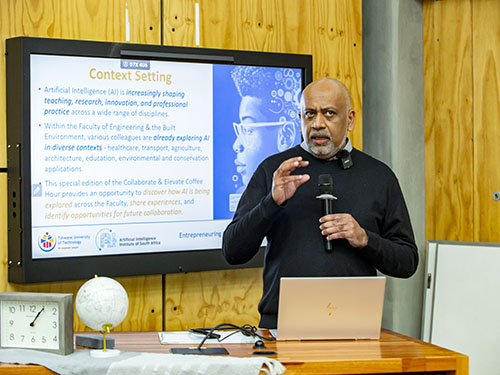 Director of the TUT AI Hub, Prof Anish Kurien, highlighted the importance of collaboration in advancing AI research, teaching and innovation.
He pointed to the wide range of AI-related work taking place across FEBE, with academics applying the technology in healthcare, transport, agriculture, education, virtual reality and wildlife conservation. He encouraged participants to share experiences, ask questions and identify opportunities for collaborative research and innovation.
Director of the TUT AI Hub, Prof Anish Kurien, highlighted the importance of collaboration in advancing AI research, teaching and innovation.
He pointed to the wide range of AI-related work taking place across FEBE, with academics applying the technology in healthcare, transport, agriculture, education, virtual reality and wildlife conservation. He encouraged participants to share experiences, ask questions and identify opportunities for collaborative research and innovation.
"Innovation seldom happens in isolation," said Prof Shongwe. "It happens when an engineer works alongside an agriculturist, when an educator collaborates with a technologist and when we recognise that the solution to a challenge in one discipline may lie in the expertise of another."
Prof Anish Kurien, Director of the TUT AI Hub, outlined the vision behind the newly launched TUT AI Conversations - FEBE Chapter. He explained that the initiative was established to bring AI conversations closer to the Faculty, while complementing the work of the institutional TUT AI Hub.
According to Prof Kurien, artificial intelligence is rapidly transforming research, innovation, technology development, teaching and learning. He said universities must embrace the opportunities AI presents while also addressing important considerations such as ethical use of AI and academic integrity.
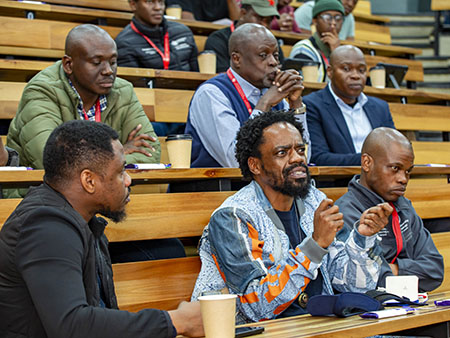 Academics from across FEBE came together to explore how artificial intelligence is shaping teaching, research and innovation.
He added that many academics across FEBE are already incorporating AI into their teaching and research, often working independently. The new chapter aims to raise awareness of existing initiatives, encourage knowledge sharing and create opportunities for collaborative projects with wider impact.
Academics from across FEBE came together to explore how artificial intelligence is shaping teaching, research and innovation.
He added that many academics across FEBE are already incorporating AI into their teaching and research, often working independently. The new chapter aims to raise awareness of existing initiatives, encourage knowledge sharing and create opportunities for collaborative projects with wider impact.
"When we work in isolation, our impact is limited. But when we come together, share ideas and learn from one another, we can achieve far more," he said. "This platform is about building a community of practice where academics can exchange experiences, explore collaborations and collectively shape the future of AI in FEBE."
The programme featured a series of presentations highlighting AI applications across multiple disciplines, including health, education, transport, agriculture, poultry production, wildlife conservation and virtual reality.
Dr Prosper Sotenga, Senior Lecturer in Electrical Engineering, talked about how artificial intelligence is helping South Africa's smallholder crop farmers. His research focuses on practical technologies that support farmers in improving productivity, adapting to changing climate conditions, addressing energy-related challenges and strengthening access to markets.
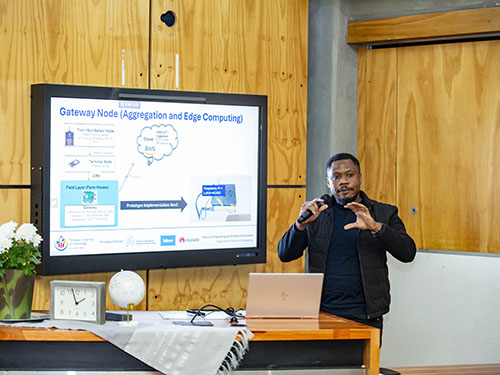 Dr Prosper Sotenga presented his AI-driven research aimed at developing smart technologies to support South Africa's smallholder crop farmers.
The project involves collaboration with partners including the University of the Witwatersrand, Huawei, Telkom and other stakeholders, demonstrating how academia and industry can work together to develop technology-driven solutions for the agricultural sector.
Dr Prosper Sotenga presented his AI-driven research aimed at developing smart technologies to support South Africa's smallholder crop farmers.
The project involves collaboration with partners including the University of the Witwatersrand, Huawei, Telkom and other stakeholders, demonstrating how academia and industry can work together to develop technology-driven solutions for the agricultural sector.
The event also highlighted the growing role of AI in environmental conservation.
Johan Benade, Lecturer in Mechanical and Mechatronics Engineering, showcased technologies designed to strengthen anti-poaching efforts in South African game reserves. His presentation featured a smart monitoring device capable of detecting fence tampering and immediately alerting reserve authorities to potential security breaches.
Benade also demonstrated fixed-wing drones equipped with advanced sensors to detect intruders from the air, as well as robotic platforms that simulate poachers' movements and collect field data to improve anti-poaching strategies.
The projects illustrated how artificial intelligence, robotics and engineering can work together to develop practical technologies that support wildlife conservation and help protect South Africa's biodiversity.
By bringing together expertise from across disciplines, the Collaborate & Elevate Coffee Hour reinforced FEBE's commitment to fostering collaboration, advancing innovation and creating new opportunities for academics to shape the future of AI-driven research and development.
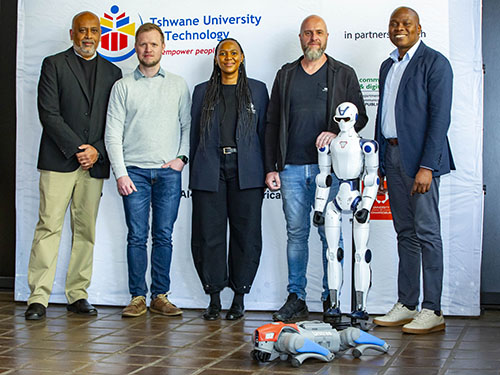 From left, Director of the TUT AI Hub, Prof Anish Kurien, Antonie Smith of the TUT AI Hub, Chair of the FEBE Collaborate and Elevate, Molebogeng Makofane, Prof Nico Steyn from the Department of Electrical Engineering and FEBE Executive Dean, Prof Mxolisi Shongwe.
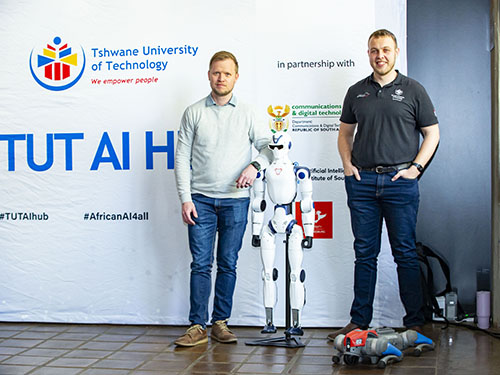 Antonie Smith and Cornelius Meyer of the TUT AI Hub.
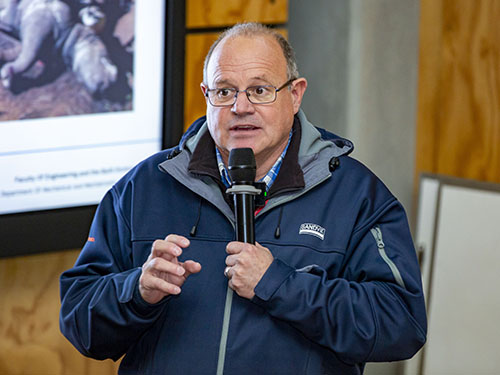 Johan Benade showcased AI-powered technologies designed to strengthen wildlife conservation and support anti-poaching efforts.