MALAIKA MAHLATSI | Prof Maserumule, Black geographies and the future of The People’s University
AcademicsDesk of the VC - Prof Tinyiko Maluleke
23 November 2026
While Maserumule is best-known as a foremost authority on building state capacity and public-sector reform, it is his work on Black geographies that demands greater reflection.
First published in EWN on 23 November 2026 by Malaika Mahlatsi
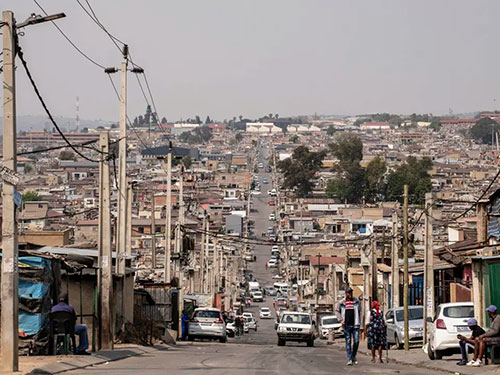 A general view of a street in Alexandra township, in Johannesburg, South Africa, August 27, 2025. Picture: OUR CITY NEWS/Ihsaan Haffejee.
A few days ago, the Council of the Tshwane University of Technology (TUT) communicated its decision to appoint its current Executive Dean of the Faculty of Humanities, Professor Mashupye Maserumule, as its next Vice-Chancellor and Principal.
The appointment is effective from 1 February 2027. Maserumule, a renowned public administration scholar and national policy advisor, recently served on the National Planning Commission (NPC) and led a High-Level Ministerial Panel on the Professionalisation of the Public Sector.
His evidence-based research directly informed South Africa’s 2026 Revised Paper on Local Government, which updates the 1998 policy framework to address municipal financial distress, service failures, and weak governance.
While Maserumule is best-known as a foremost authority on building state capacity and public-sector reform, it is his work on Black geographies that demands greater reflection.
A decade ago, a progressive academic from Arizona State University, Professor Rashad Shabazz, published a brilliant book titled Spatializing Blackness: Architectures of Confinement and Black Masculinity in Chicago.
It is an interdisciplinary study that highlights the racialisation of space, the role of containment in subordinating and disenfranchising African Americans, the politics of mobility under conditions of liberal democracy, and the ways that Black communities negotiate and resist spatial injustice.
In the book, he references the work of geographer Katherine McKittrick, whose field-defining text for Black geographers, Demonic Grounds: Black Women and the Cartographies of Struggle, introduces us to the profound argument that “Black matters are spatial matters”.
This argument is centred on three core arguments. The first pertains to inherent spatiality - that Black experiences, from the historical trans-Atlantic slave trade and plantations to modern urban segregation, cannot be understood separately from physical geography.
The second pertains to racism as spatial domination, which is grounded in the argument that White supremacy and racism do not just operate through social prejudice and economic subjugation, but that they function spatially.
They dictate where Black people can live, move, or feel safe, and where they are exposed to environmental hazards, health risks, poverty, and policing.
The third core argument pertains to the erasure of place. Dominant societal structures erase and devalue Black people's claims to home, land, and a meaningful sense of place.
Central to Shabazz and McKittrick’s works is the contention that Black life, history, and liberation struggles are fundamentally tied to geography, space, and place.
Maserumule, who supervised my Master’s thesis on the impact of COVID-19 on urban food security in South Africa, with a specific focus on the City of Ekurhuleni’s response to the global pandemic that devastated national economies six years ago, has grounded his theorisation on the decolonisation of higher education in the value of Black geographies.
During his supervision of my work, he impressed on me the importance of employing a sociological imagination in how I engaged with the impact of the pandemic restrictions on practices of Black people in townships.
This grossly under-studied impact of the pandemic helps us to understand how people living in townships negotiated existence during the pandemic, and why Black spatiality had such a significant impact on which areas became its epicentres.
Maserumule coined and theorises the term “the people’s university”, as TUT is known, to not only describe TUT, but to locate it within the geo-history and future of South African society.
TUT is the largest residential university in our country. This is not what makes it a distinct institution. The core distinction of the university lies in its location and the students that it serves.
The university has seven campuses across the Gauteng, Limpopo, and Mpumalanga provinces, with an additional campus planned in Giyani, Limpopo.
Most of its campuses are located in townships and serve a student population that is overwhelmingly working-class and Black. Roughly 60 000 of the university’s students are funded by the National Student Financial Aid Scheme (NSFAS), with most of the funding directed at undergraduate students.
This student population represents people who were historically marginalised and who are on the receiving end of structural inequalities and poverty in South Africa. The location of the university’s campuses in townships expands higher education access and stimulates local economies where residents live.
Universities act as anchor institutions that create jobs, buy goods and services from local suppliers, and attract foot traffic that supports township businesses.
Furthermore, campus developments spur improvements in roads, public transport, utilities, and public spaces from municipalities and national/provincial governments.
Just as significantly, it helps in reversing apartheid spatial planning. The apartheid regime placed townships far from economic and educational hubs, creating long, costly commutes and ongoing socio-economic barriers.
Placing university campuses inside townships brings higher education directly into historically underserved communities. In so doing, the nature of scholarship that emerges from such universities is significantly shaped.
TUT has introduced modules in its Department of Public Management that go beyond the conventional syllabi that many other universities have.
These include Urban Planning and Local Government Economic Development as well as Environmental Management and Sustainable Development.
Centering these in public administration matters significantly, especially as cities play an increasingly important role in countries in the Global South. Townships, as a feature of South African cities, are an especially important area that necessitates study in issues of spatiality.
Maserumule, as a scholar, and TUT as an institution, understood this at a time when Public Administration as a discipline was not too invested in Black geographies.
But as McKittrick and Shabazz correctly argued, Black matters are spatial matters. It is incongruent with logic to theorise the South African public service, or manage its public affairs, without centering the histories as well as current and future realities of Black people who are located in townships, rural areas and tenement districts.
In appointing Maserumule to lead it into the future, TUT did not simply appoint a person who is qualified in terms of academic credentials, reputation and managerial experience.
It also appointed someone who understands the role of the African university as what the late Robert Sobukwe described as “a barometer of African thought” – an institution that does not rely on a Eurocentric model to theorise African society and the components that make it up.
For far too long, Vice-Chancellors have been seen as nothing more than administrators and functionaries within the higher education system. But they are more than this. They are the ideational centre of institutions, and TUT has cemented itself as the ideational theatre for Black geographies and a multidisciplinary approach to public administration and management.
This is a victory for the institution, for the public service in South Africa and perhaps most importantly, for the communities and townships that are home to the institution’s campuses.
As scholars of Geography and practitioners of public administration, we have a responsibility to support TUT as it seeks to define the place of the university in Africa.
Malaika is a bestselling author and researcher. She is a PhD candidate in Geography at the University of Bayreuth in Germany.