Lion conservation mission showcases TUT alumna’s impact in the wild
Academics
1 September 2026
Tracking one of South Africa’s most important free-roaming lion populations has become part of daily life for TUT alumna, Nonkululeko Mokobong, who is helping to lead critical conservation work in the Kgalagadi Transfrontier Park. As a field technician with the Endangered Wildlife Trust (EWT), she forms part of a team conducting a three-month lion population census that will support conservation planning and long-term ecosystem management across South Africa and Botswana.
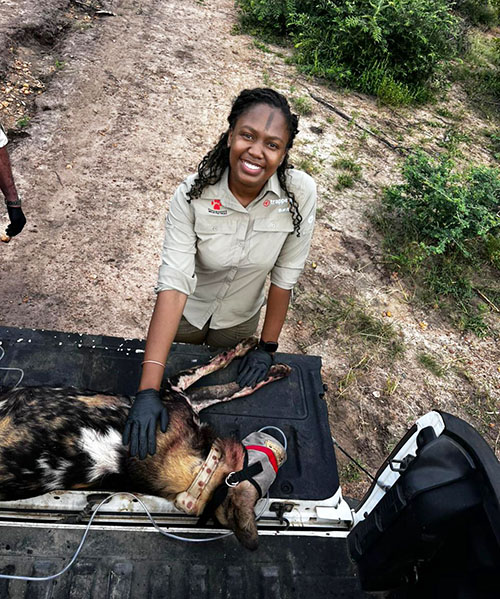 TUT alumna, Nonkululeko Makobong.
Mokobong, an EWT field technician and TUT Advanced Diploma in Nature Conservation student, spends much of her time in the Kgalagadi monitoring lions, collecting data and supporting efforts to better understand one of South Africa’s most significant wild lion populations. Based in Hoedspruit in the EWT's Carnivore Conservation and Birds of Prey units, she returns to Pretoria every three months for contact sessions as she completes her studies at TUT.
TUT alumna, Nonkululeko Makobong.
Mokobong, an EWT field technician and TUT Advanced Diploma in Nature Conservation student, spends much of her time in the Kgalagadi monitoring lions, collecting data and supporting efforts to better understand one of South Africa’s most significant wild lion populations. Based in Hoedspruit in the EWT's Carnivore Conservation and Birds of Prey units, she returns to Pretoria every three months for contact sessions as she completes her studies at TUT.
Mokobong credits her TUT education with laying the foundation for her conservation career. She said her diploma provided a strong introduction to species and reserve management while a year of compulsory practical training exposed her to camera trapping, predator surveys and field research.
“That’s when I worked with camera traps for the first time and predator surveys. It really enabled me to become a strong EWT field officer in the Kgalagadi,” she said.
Her passion for lions inspires her work in the field.
“Lions are a very powerful and mighty entity in the wild. I love how they naturally command respect from other animals in the ecosystem. They are incredibly beautiful animals and there’s nothing more peaceful than listening to a lion’s roar outside camp when you’re trying to fall asleep in the bush.”
Mokobong forms part of an EWT team that returned to the Kgalagadi Transfrontier Park on 1 August to conduct this year’s lion population census in partnership with SANParks. The project runs until 31 October and follows a three-month survey conducted in 2025 that collected the first tranche of data on lions living in this unique desert ecosystem.
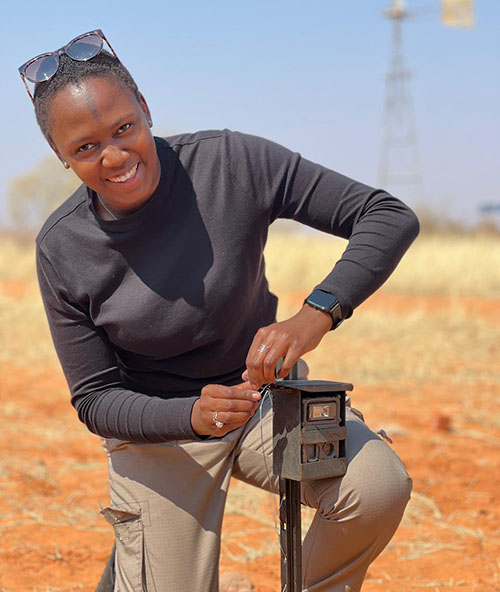 The research aims to determine the estimated number of lions in the South African section of the Transfrontier Conservation Area as well as their demographics and distribution across the park. At the same time, a team from Kalahari Research and Conservation is conducting similar work on the Botswana side.
Alison Govaerts, EWT Carnivore Conservation Unit Data Analyst, leads the six-member team, supported by Marnus Roodbol, EWT Project Manager. Mokobong works alongside fellow field technicians Lesedi Leope, Sabelo Mahlangu and Lizaene Cornwell.
The researchers use photographs and camera-trap footage to identify individual lions by their unique whisker patterns. At the end of the project, survey results from both countries will be combined to produce an estimate of lion numbers across the entire Transfrontier Park while avoiding double counting of animals that move freely across borders.
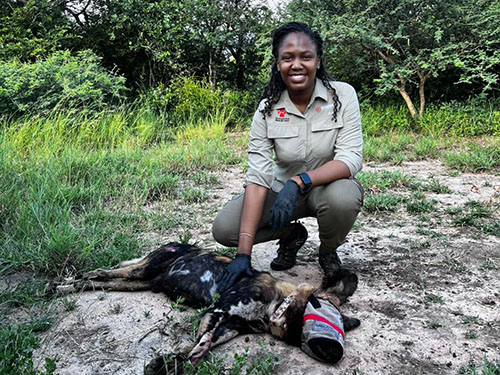 Repeated surveys will provide a foundation for long-term monitoring of the Kgalagadi lion population, which is the second-largest free-roaming lion population in South Africa. The information will support national lion conservation planning and help SANParks manage lion populations effectively.
The project also highlights the ecological, economic and cultural importance of lions. As apex predators, lions help maintain balanced ecosystems by regulating prey populations and limiting meso-predator numbers. They also remain one of the most sought-after wildlife sightings for visitors and hold deep cultural significance as symbols of strength, leadership and identity.
Supported by SANParks, the Lion Recovery Fund and private donors, the initiative represents an important step in strengthening lion conservation while showcasing the meaningful contribution that TUT graduates are making to protecting South Africa’s natural heritage.
- Information provided by the Endangered Wildlife Trust