Lecturer makes history with TUT’s first jewellery doctorate
Academics
15 October 2026
By Gerrit Bester
Nina Newman, a lecturer in the Department of Fine and Studio Arts’ Jewellery Programme at the Tshwane University of Technology (TUT), made history when she became the first recipient of a Doctor of Art and Design (Jewellery Design and Manufacture) degree conferred by TUT at the Faculty of Arts and Design graduation ceremony on the Pretoria Campus on 13 October 2026. Her achievement marks a significant milestone for both her and the field.
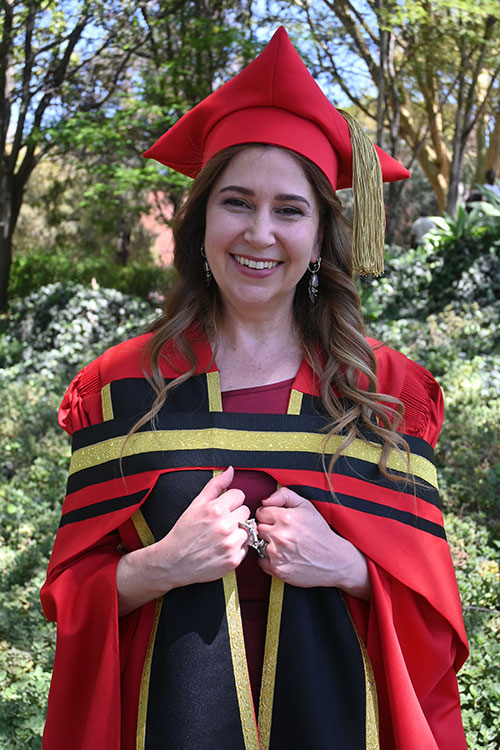 Dr Nina Newman, newly awarded doctorate holder and lecturer in the Jewellery Programme. PHOTO: Gerrit Bester
Tell us more about your academic and professional journey to this point. I have been a lecturer in the Jewellery Programme at TUT since 2000 and completed a Master’s in 2015. I am a qualified goldsmith and a multi-award-winning jewellery designer, and I participate in various contemporary jewellery exhibitions. I believe it is important to be a practitioner in what you teach and to be actively involved in your industry.
Dr Nina Newman, newly awarded doctorate holder and lecturer in the Jewellery Programme. PHOTO: Gerrit Bester
Tell us more about your academic and professional journey to this point. I have been a lecturer in the Jewellery Programme at TUT since 2000 and completed a Master’s in 2015. I am a qualified goldsmith and a multi-award-winning jewellery designer, and I participate in various contemporary jewellery exhibitions. I believe it is important to be a practitioner in what you teach and to be actively involved in your industry.
Your doctoral dissertation is titled Unveiling Artistic Narratives: Exploring the Contemporary Jewellery Praxis of Selected South African Women. What inspired you to pursue this particular area of research? I knew that I wanted to focus my doctoral studies on contemporary jewellery in South Africa because it is such a niche practice and relatively little has been written about its praxis. Through my participation in exhibitions and my contact with various contemporary jewellery galleries, I noticed that many of the jewellers and gallery owners I encountered were women. This observation shifted my focus specifically towards women and made me interested in exploring how their experiences influence their contemporary jewellery practices.
What does this achievement mean to you personally and professionally? Personally, I feel proud of reaching this point and appreciate the acknowledgement of the work that has gone into my doctorate. Professionally, the achievement means a great deal to me because there are relatively few doctoral researchers in the jewellery discipline, both in South Africa and globally. I feel honoured to now be part of this group of researchers. However, I see my doctorate as the beginning of my research journey rather than the end. My aim is to continue producing research that contributes to the understanding and development of the South African jewellery discipline.
Who were your supervisor(s) and how important was their guidance during your Doctoral journey? My supervisors were Prof Anne Mason, Head of Department of Fashion Design, and Prof Nalini Moodley, Executive Dean of the Faculty of Arts and Design. Their guidance was vital throughout my doctoral journey. They each brought different views and strengths to the supervision process, which allowed me to approach my research from multiple perspectives. Their practical guidance, particularly during the early stages of my study, helped me to shape and clarify my research. I am very grateful for their continued support and guidance throughout the journey.
How important is it to select the right supervisor and to build a positive working relationship with them? I think selecting the right supervisor and building a positive working relationship with them is crucial for any postgraduate student. I specifically selected my supervisors because they brought different strengths to my research and I was fortunate that they agreed to supervise me. A doctoral journey can be stressful and having a positive relationship with your supervisors provides not only academic guidance but also the mental and emotional support needed to navigate the challenges of the process. For me, being able to communicate openly with my supervisors and trust their guidance was an important part of completing the doctorate.
For readers who may be unfamiliar with the field what is contemporary jewellery praxis, and why is it an important area of study? Contemporary jewellery can be understood as jewellery that goes beyond its traditional function as adornment, placing greater emphasis on the maker’s intentions and creative process. Consequently, contemporary jewellery often engages with specific concepts or theoretical ideas, or explores innovative materials, techniques and methods of making. This relationship between the thinking, making and resulting work is termed jewellery praxis.
Praxis was pivotal to my study as I sought to understand not only the jewellery produced by the women but also the experiences, ideas and processes that shaped their practices. My research focused on how their contemporary jewellery praxis mirrored their lived experiences, thus making this concept central to my investigation.
Briefly explain the key findings of your research and how they contribute to the current body of knowledge in the Visual Arts and Design. My research found that the contemporary jewellery practices of the selected South African women were closely connected to their lived experiences and identities. Factors such as family, education, culture, gender, nationality and the South African context influenced the themes, materials and techniques they used. I also found that contemporary jewellery provided a way for them to express and make meaning of these experiences.
The study contributes to the visual arts and design by providing research into a relatively underexplored area of South African contemporary jewellery. It connects the participants’ lived experiences and identity formation to their jewellery practices and contributes to a greater understanding of contemporary jewellery within the South African context.
What did you find most rewarding and most challenging about completing a Doctorate? Apart from completing my doctorate, the most rewarding aspect has been that my research brings recognition to contemporary jewellery in South Africa and to the many women practitioners and their work.
There were many challenges, including limited research in the jewellery discipline and periods when it was difficult to maintain momentum in the writing. But I think the most challenging part was that your study becomes part of your everyday life. For years, you eat, think and sleep your research, and you have to learn to put the doctorate first and remain academically responsible for your studies. That was challenging, but it was also part of what made completing it so meaningful.
How important is research output in the arts and how can it help advance the creative industries and society more broadly? I think research in the arts, particularly in South Africa, is vital. There is still a lack of research in many areas of the arts and this becomes more evident when looking at specialised fields such as contemporary jewellery. My research is an example of this, as relatively little is known about contemporary jewellery in South Africa, despite the fact that we have internationally renowned practitioners whose work is not always recognised locally.
Research outputs, whether journal articles or creative research outputs, help to document these practices and bring greater visibility to the artists and disciplines involved. This can generate interest, create opportunities for practitioners and contribute to the development of the creative industries. More broadly, research in the arts helps society understand and value the cultural practices and creative work that form part of our South African identity.
What are your current research interests and how do you see them developing in the future? I have so many! During my doctoral study, I kept noting different areas within the jewellery discipline that I would like to explore further. My main research interest remains contemporary jewellery in South Africa and I would like to continue writing about the field and contributing to its body of knowledge.
I am also considering writing a book on South African contemporary jewellery, which I think could be valuable for both the industry and our academic programmes. At the same time, I would like to return to my creative practice. I would love to participate in exhibitions again, spend time at the bench and make contemporary jewellery.
Looking further ahead, I would like to expand my research into jewellery design more broadly, while continuing to locate that research within the South African context.
What advice would you give to colleagues who are currently pursuing Doctoral studies or considering enrolling for a Doctorate? I strongly recommend ensuring you are in the right headspace before starting a doctorate and that you understand the commitment it requires. Your studies will take up a significant part of your time and personal life, so you need to be dedicated to the process from the beginning.
There are many deadlines to meet, particularly during the early stages of research, so managing your time is important. I also recommend working on your research consistently, even if only for a short period each day. Once you step away from your research for several days, it can be difficult to re-engage. Most importantly, be prepared for the fact that a doctorate is a long process and that maintaining momentum is important. It is a marathon sprint!
How would you encourage current students to pursue postgraduate studies and, potentially, a research career in the arts? I would encourage students to look at the many areas within the arts and design that still need to be explored, particularly within a South African context. There are many aspects of our disciplines that are not represented in global narratives and this creates opportunities for students to contribute new knowledge through their research.
I have seen students select topics that they are not familiar with or that do not connect with their interests. For a research project that requires such a long-term commitment, I think it is important to choose a topic that you are genuinely interested in and that builds on your existing knowledge. I would encourage students to find research that connects their interests, their discipline, their local environment and their own experiences.
Now that you have reached this milestone, what are your academic and professional ambitions for the next phase of your career? Academically, I would like to focus on developing my research outputs, both through journal articles and creative research outputs. I would also like to get the ball rolling on a book on South African contemporary jewellery with the aim of distributing a call for contributions to South African contemporary jewellers this year. I see this as an opportunity to continue the work I started through my doctorate and contribute further to the documentation of our field.
Professionally, my main focus at present is on the re-curriculation of our programme. This will be a significant focus for me alongside my teaching and committee responsibilities.