In first for Africa, TUT unveils only on-campus CT training facility of its kind
Academics
24 April 2026
In a first for Africa, the official opening of the Tshwane University of Technology’s Radiography Clinical Skills Centre at the Arcadia Campus, now home to a state-of-the-art Revolution ACT CT Scanner (8SL) made possible through a significant educational sponsorship from GE Healthcare, was a watershed moment.
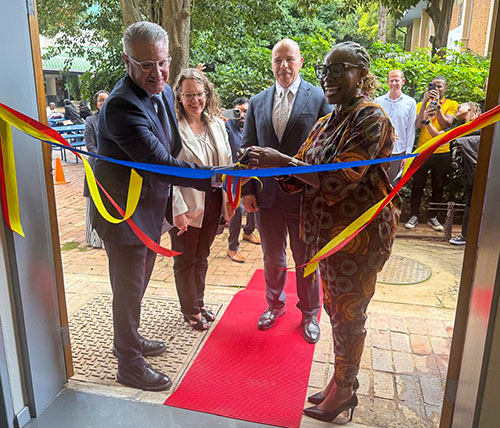 Opening doors to the future of healthcare—Mr Colin Atkinson, General Manager: Southern Africa GE Healthcare, and the Executive Dean, Professor Ntebogeng Mokgalaka – Fleischmann, inaugurate TUT’s Radiography CT unit, advancing innovation, training, and industry collaboration. Pictured behind are Prof Yolanda Havenga, Assistant Dean, Teaching & Learning (Health Sciences), and Dr Mohamed Haroun, General Manager: GE HealthCare Middle East, Turkey & Africa.
This landmark installation positions the TUT as the only institution in Africa - and indeed across the Middle East - with on-campus computerised tomography (CT) equipment dedicated to student training, setting a new benchmark for radiography education and applied health sciences.
Leadership from both the University and GE Healthcare, along with academic staff, students and industry partners, attended the opening ceremony to celebrate what is widely regarded as a transformative moment in healthcare education on the continent. The installation of the CT scanner is the culmination of a multi-year journey that began with industry engagement and culminated in a R2.5 million educational grant awarded in 2021, enabling the Faculty of Science to significantly enhance its teaching and research capabilities.
Speaking after the event, Dr Mohamed Haroun, General Manager for GE Healthcare Middle East, Turkey and Africa, highlighted the significance of the moment, saying that TUT now stands alone in the region with such an advanced on-campus facility. “This milestone represents far more than a new facility. It reflects GE Healthcare’s shared commitment to training, building critical skills, and enabling research that will shape the future of healthcare. By providing access to advanced technology and hands-on learning environments, we are helping prepare the next generation of healthcare professionals to meet tomorrow’s challenges with confidence and capability,” he said.
He emphasised that strong healthcare systems are built on well-trained people, continuous learning and innovation, adding that the centre reinforces the importance of partnerships between industry and academia in driving meaningful and lasting impact.
The Radiography programme at TUT, now more than four decades old, has long played a critical role in addressing South Africa’s shortage of diagnostic radiographers. Established in 1984 with just 12 students, the programme has evolved into one of the University’s most established and respected offerings, consistently responding to the needs of the public and private healthcare sectors. The addition of the CT scanner represents a decisive step forward in this legacy, bringing world-class medical imaging technology directly into the learning environment.
This development has far-reaching implications. For students, it introduces unprecedented access to hands-on, on-campus training that is no longer limited by the availability of external clinical placements. Aligning practical training with academic schedules enhances learning flexibility and significantly improves competency development. For academic staff, the facility strengthens the integration of teaching, research and innovation, ensuring that the curriculum remains aligned with current industry standards and technological advancements. For the broader healthcare system, it contributes to the development of highly skilled radiographers equipped to improve diagnostic accuracy and patient outcomes.
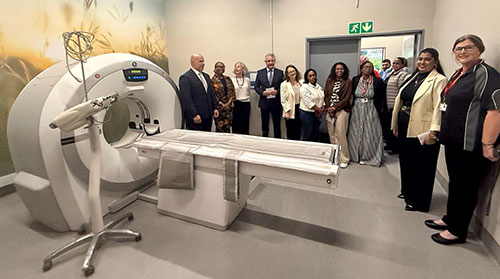 Delegates from GE Healthcare and leadership from the Faculty of Science inside the newly commissioned Radiography Clinical Skills Centre, showcasing the state-of-the-art CT scanner.
The establishment of the CT-enabled Radiography Skills Centre is also a direct expression of the University’s Institutional Strategic Plan (ISP) and the Faculty of Science’s commitment to “Entrepreneuring the Future.” This strategic vision emphasises relevance, innovation and impact, and is brought to life through initiatives that integrate experiential learning with real-world technologies. By embedding advanced CT training within its academic offering, the University is not only responding to current healthcare demands but actively anticipating future needs, ensuring that graduates are adaptable, forward-thinking and industry-ready.
Delegates from GE Healthcare and leadership from the Faculty of Science inside the newly commissioned Radiography Clinical Skills Centre, showcasing the state-of-the-art CT scanner.
The establishment of the CT-enabled Radiography Skills Centre is also a direct expression of the University’s Institutional Strategic Plan (ISP) and the Faculty of Science’s commitment to “Entrepreneuring the Future.” This strategic vision emphasises relevance, innovation and impact, and is brought to life through initiatives that integrate experiential learning with real-world technologies. By embedding advanced CT training within its academic offering, the University is not only responding to current healthcare demands but actively anticipating future needs, ensuring that graduates are adaptable, forward-thinking and industry-ready.
The project itself required extensive planning and coordination, from infrastructure development and budgeting to installation and compliance with stringent radiation safety regulations. The successful commissioning of the CT scanner stands as a testament to the dedication of academic, technical and leadership teams, as well as the strength of the partnership with GE Healthcare. It also highlights the growing importance of industry collaboration in higher education, particularly in fields where technological advancement is rapid and resource intensive.
Beyond its immediate academic value, the Radiography Clinical Skills Centre represents a long-term investment in healthcare excellence. By enabling continuous skills development, supporting applied research and fostering innovation, the facility is poised to contribute meaningfully to improved healthcare delivery in South Africa and beyond. It reflects a shared vision between TUT and GE HealthCare to expand access to advanced technology while empowering the next generation of healthcare professionals.
As the doors of this pioneering facility open, it signals not just the arrival of new equipment, but the beginning of a new era in radiography education - one defined by access, innovation and impact, and firmly aligned with the University’s mission to shape the future through knowledge, partnership and purpose.