From Pretoria to Malmö: TUT Visual Communication students begin a transformative exchange in Sweden
Academics
19 January 2026
As the Faculty of Arts and Design at the Tshwane University of Technology (TUT) steps into 2026, the year has already been framed with a clear intention.
The Executive Dean, Prof Nalini Moodley, has declared 2026 the Year of Collaboration within the faculty, a call to deepen partnerships, expand international engagement and foreground collective knowledge-making across disciplines and borders. Fittingly, the departure of four Visual Communication students on an international exchange to Sweden marks a powerful and symbolic beginning to this theme.
In the early hours of mid-January, while most of South Africa slept, these four students were crossing continents, climates and expectations. Their destination: Malmö University, one of Scandinavia’s leading institutions for socially engaged design, film and interaction studies.
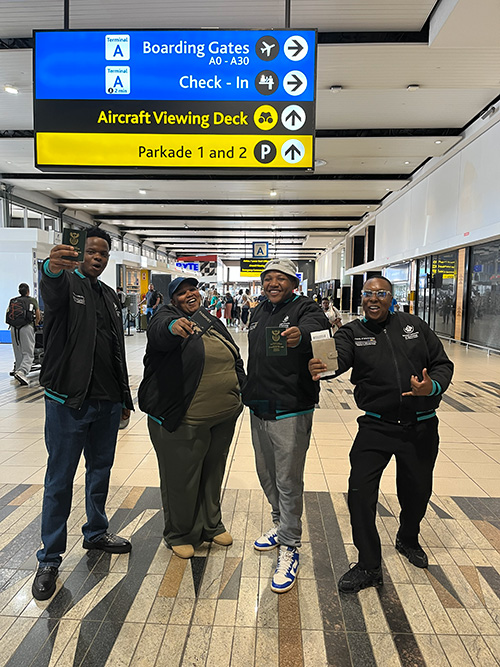 Ahead of their Swedish adventure, Gosiame Sebopela, Oyama Bronwyn Mdoda, Akido Malabela and Mokoena Lenea John share a buzz of anticipation as they pose at OR Tambo International Airport in Johannesburg, moments before take-off.
The cohort represents all disciplines at the Department of Visual Communication. Akido Malabela joins the exchange from Commercial Photography, Gosiame Sebopela and Mokoena Lenea John represent Integrated Communication Design and Oyama Bronwyn Mdoda comes from Motion Picture Production. Together, they embody an interdisciplinary approach to visual storytelling, design thinking and socially responsive creative practice, precisely the kind of collaboration the faculty aims to advance in the year ahead.
Ahead of their Swedish adventure, Gosiame Sebopela, Oyama Bronwyn Mdoda, Akido Malabela and Mokoena Lenea John share a buzz of anticipation as they pose at OR Tambo International Airport in Johannesburg, moments before take-off.
The cohort represents all disciplines at the Department of Visual Communication. Akido Malabela joins the exchange from Commercial Photography, Gosiame Sebopela and Mokoena Lenea John represent Integrated Communication Design and Oyama Bronwyn Mdoda comes from Motion Picture Production. Together, they embody an interdisciplinary approach to visual storytelling, design thinking and socially responsive creative practice, precisely the kind of collaboration the faculty aims to advance in the year ahead.
The journey itself already felt symbolic. Delayed flights, a power outage at OR Tambo International Airport, traffic congestion on the R21 and last-minute logistics tested their resolve. Yet, as messages flowed through the night, “We worked as a team,” it became clear that collaboration, adaptability and calm under pressure would define this exchange from the very start.
By the next morning, the students touched down in Denmark before navigating their way across the Øresund to southern Sweden. By the afternoon, the contracts for student housing had been signed and the bags had been unpacked. The reality of a Scandinavian winter had set in: temperatures of 5°C and darkness falling just after 16:00, prompting a newfound appreciation for the jackets packed back home. “Those jackets are helping us a ton,” came one grateful message.
From conference conversation to campus reality
Behind the scenes, the exchange programme was the result of sustained academic diplomacy and institutional collaboration. The opportunity was initiated during the Southern African–Nordic University Forum (SASUF) Conference, hosted in Malmö in 2024, where Dr Herman Botes, Acting Assistant Dean: Faculty of Arts and Design, engaged in strategic discussions with Prof Josepha (Joshka) Wessels, Associate Professor in Media and Communication Studies – Communication for Development, at Malmö University. What began as a conference dialogue around shared values, socially responsive design, creative research and global citizenship, evolved into concrete negotiations to enable student mobility between the two institutions.
The International Office in the Office of the Deputy Vice-Chancellor: Research, Innovation and Engagement at TUT was instrumental in translating these academic intentions into institutional reality. Through coordinated legal, administrative and strategic processes, the office facilitated the Memorandum of Understanding that formalised the partnership and unlocked access to the Erasmus+ Programme International Credit Mobility framework. The result is an exchange that is academically robust and strategically aligned with TUT’s broader internationalisation, research and engagement agenda. The International Office at Malmö University, and Mr Niklas Nannskog in particular, went above and beyond to make this exchange possible.
Studying design, communication and catastrophe
Two of the cohort, Mokoena Lenea John and Gosiame Sebopela, will be enrolled in Interaction Design at Malmö University’s School of Arts and Communication through their Integrated Communication Design background, a discipline grounded in user-centred research, ideation and prototyping. The programme challenges students to design interactive solutions that respond to real human needs, with a strong emphasis on sustainability, accessibility and social impact.
For Lenea, the exchange arrives at a pivotal moment. Preparing to further his studies and aspiring to a career in lecturing, he views the international experience as a means to broaden his research lens beyond South Africa. His interests are shaped by lived experience, particularly how language barriers within higher education can affect students’ academic and social participation. Malmö’s multicultural classrooms and research-driven design culture offer fertile ground to explore these questions from a global perspective.
Gosiame speaks of becoming a designer who can “positively influence and guide human behaviour.” Over the next six months, he plans to immerse himself in Sweden’s design culture of sustainability, social responsibility and user-focused solutions, while learning from peers across diverse cultural and disciplinary backgrounds.
Imagining catastrophe, community and creative networks
From Commercial Photography, Akido Malabela, founder of Malabela Photography, brings a strong entrepreneurial and community-oriented practice to Malmö. During his exchange, he will study Imagining Catastrophe, a course that examines how catastrophe is imagined across psychic, philosophical and social spaces, in fiction, film, policy, design and disaster planning, and how such imaginaries have become part of everyday social life.
He will also engage with Communication for Development and Social Change – Engaging Communities, closely aligned with his passion for working with communities and learning from different cultures and traditions. Beyond the classroom, Akido plans to explore Sweden and neighbouring countries via public transport, build networks with fellow creators, study how galleries curate exhibitions and collaborate with Swedish artists to learn new workflows and stylistic approaches, particularly in event photography. Having worked for more than six years towards this goal, he is determined to make the most of every aspect of the experience, even down to learning basic greetings in Swedish, Danish, Norwegian and French.
Filmmaking, identity and global storytelling
Representing Motion Picture Production, Oyama Bronwyn Mdoda will study Filmmaking at Malmö University’s School of Arts and Communication (K3). The exchange is central to her postgraduate research on the representation of African characters in scriptwriting and visual storytelling. Oyama has also been selected for the Nurturing Emerging Scholars Programme (NESP) that is funded by the University Capacity Development Programme (UCDP).
As an African storyteller, she is driven by a guiding question: “What is the African identity when no one is watching and how do I write that truth into film?” At Malmö, she aims to explore how different cultures approach storytelling while remaining rooted in her South African identity, seeking ways to present authentic African narratives to global audiences without surrendering dignity or reinforcing stereotypes.
Learning in an international environment, she believes, will deepen her growth as both a filmmaker and a future educator. Spending six months in Sweden is a deliberate step toward becoming the kind of lecturer who empowers students to tell their stories with authenticity, confidence and purpose.
More than a trip abroad
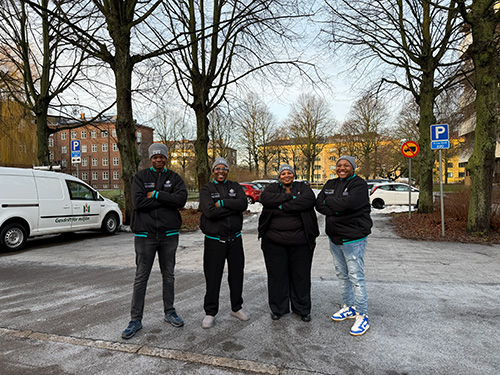 A touch cooler than their send-off South Africa, the foursome arrived in Malmö snug and steady, decked in TUT gear and ready to brave the chilly but exciting new chapter.
Beyond credit transfer and coursework, this exchange represents a deeper investment in people, partnerships and knowledge circulation and an early, tangible expression of the Faculty of Arts and Design’s Year of Collaboration. As the students settle into their new routines, navigating public transport, adjusting to short winter days and preparing for intensive coursework, they carry with them the responsibility of representation. They are ambassadors not only for TUT, but for the Faculty of Arts and Design and the Department of Visual Communication as a whole.
A touch cooler than their send-off South Africa, the foursome arrived in Malmö snug and steady, decked in TUT gear and ready to brave the chilly but exciting new chapter.
Beyond credit transfer and coursework, this exchange represents a deeper investment in people, partnerships and knowledge circulation and an early, tangible expression of the Faculty of Arts and Design’s Year of Collaboration. As the students settle into their new routines, navigating public transport, adjusting to short winter days and preparing for intensive coursework, they carry with them the responsibility of representation. They are ambassadors not only for TUT, but for the Faculty of Arts and Design and the Department of Visual Communication as a whole.
Their first days in Malmö already tell a compelling story: of teamwork forged under pressure, excitement tempered by Nordic cold and young designers and filmmakers ready to test their ideas on a global stage. When they return home later this year, they will bring back more than credits and certificates, they will return with expanded networks, sharpened perspectives and renewed purpose, ready to enrich studios, classrooms and communities in South Africa.
Hein Grové, Acting HoD of the Department of Visual Communication, captured it best: “Yesterday, they were at the airport in Johannesburg. Today they are on another continent. In that distance lies possibility.”