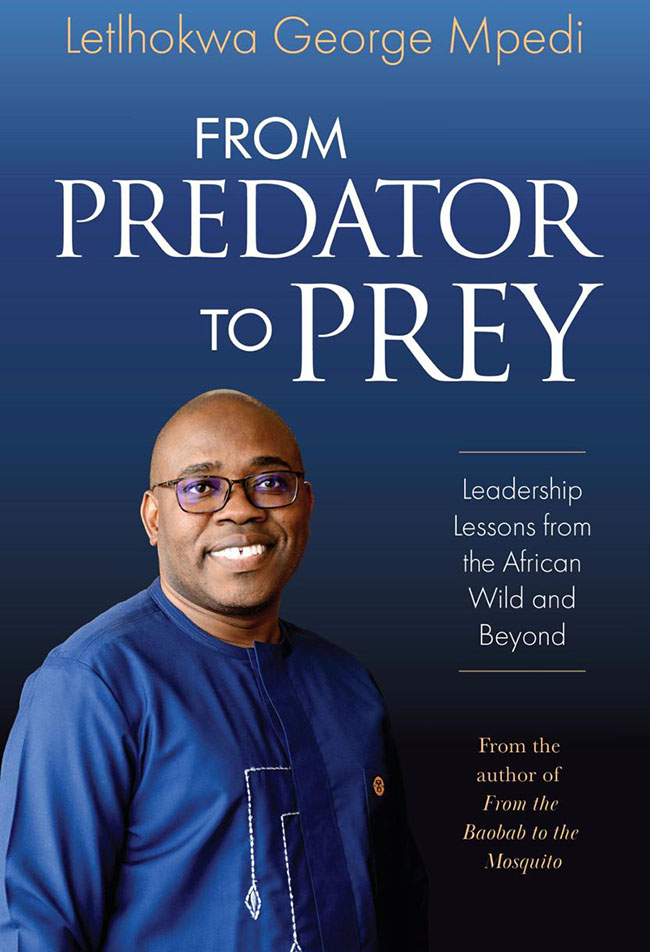
From Predator to Prey by Letlhokwa George Mpedi
AcademicsDesk of the VC - Prof Tinyiko Maluleke
2 March 2026
By Prof Tinyiko Maluleke, Vice-Chancellor and Principal
To promote the Feb 2026 TUT VC’s Book of the Month, we spoofed Dickens’ much-quoted classic A Tale of Two Cities. Hence our advertorial title: “A Tale of Two Vice Chancellors … and a Book”.
 Prof Letlhokwa George Mpedi, Vice-Chancellor of the University of Johannesburg
The truth, however, is that at the centre of our conversation on the 20th of February 2026 was the tale of one Vice Chancellor - Professor Letlhokwa George Mpedi - based on his inspirational book, From Predator to Prey: Leadership Lessons from the African Wild and Beyond.
Prof Letlhokwa George Mpedi, Vice-Chancellor of the University of Johannesburg
The truth, however, is that at the centre of our conversation on the 20th of February 2026 was the tale of one Vice Chancellor - Professor Letlhokwa George Mpedi - based on his inspirational book, From Predator to Prey: Leadership Lessons from the African Wild and Beyond.
And yet, maybe there was something a tad prophetic about our playful referencing of Dickens, whose book famously opens with the unforgettable words: “It was the best of times, it was the worst of times, it was the age of wisdom, it was the age of foolishness ….”
There is a sense in which Mpedi’s work, From Predator to Prey, discusses the important subject of leadership during a similar kind of epoch in the world. Except that ours may be the best of times for a tiny minority and the worst of times for the vast majority. Our world may be slipping into a things-fall-apart moment à la William Butler Yeats’ Second Coming - a period where “the best lack conviction and the worst are full of passion.” Although there is no dearth of books on leadership, a leadership crisis is upon the world, nevertheless.
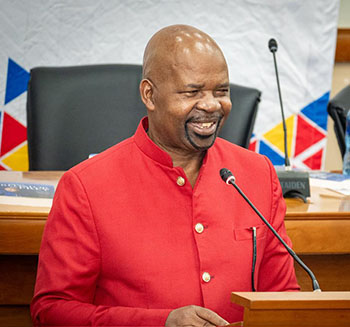 Prof Tinyiko Maluleke, Vice-Chancellor and Principal at the Tshwane University of Technology.
Mpedi’s From Predator to Prey tackles the subject of leadership from an unusual and fresh angle, namely, that of leadership lessons from the animal kingdom. In this sense, Mpedi’s book takes us back to our roots in the animal kingdom - from whence humanity comes and to which humanity belongs.
Prof Tinyiko Maluleke, Vice-Chancellor and Principal at the Tshwane University of Technology.
Mpedi’s From Predator to Prey tackles the subject of leadership from an unusual and fresh angle, namely, that of leadership lessons from the animal kingdom. In this sense, Mpedi’s book takes us back to our roots in the animal kingdom - from whence humanity comes and to which humanity belongs.
Unlike those who choose to praise humanity for having risen to the top of the food chain in the animal world by outfoxing and subduing the animal kingdom, Mpedi is cognisant and respectful of humanity’s original and continued locatedness within the animal kingdom. There is a second sense in which Mpedi’s book takes us back to our roots. Taking his cue from the African wild, Mpedi adopts a bold and deliberate African approach to leadership deeply embedded in the values of Ubuntu.
And yet, he is mindful of the extent to which engineers, entomologists, biologists, and technologists have taken inspiration and lessons from various animals to produce some of the most amazing innovations of our times. Similarly, he boldly outlines leadership lesson after leadership lesson, gleaned from the behaviours and instincts of animals.
From the hunting strategies of predators to the agility of quick-thinking antelopes and the resilience of such lone rangers as leopards, Mpedi suggests we have a lot to learn about leadership. He homes in on the child-rearing tactics, self-defence strategies, and memory rituals of animal herds - such as elephants and buffalo. In this sense, the title of Mpedi’s book should be From Predator to Prey and Everything in Between. For him, no animal is too big or too small to teach us something about leadership. The cockroach has as much to teach us about resilience as does the elephant; the honey badger has as much to teach us about persistence in leadership as does the female lion.
The leadership behaviours which Mpedi deduces and lifts up from animals are as incisive as they are insightful: persistence, collaboration, resilience, communication, symbiosis, solitude, habituation, mentoring, control, play, curiosity, and even gratitude.
 Prof Mpedi (left) and Prof Maluleke (right).
For example, from the behaviours of such animals as birds in relation to scarecrows, squirrels and pigeons in relation to human proximity, and the aplysia sea slug in relation to touch, Mpedi teaches leaders the power and the wisdom of habituation in leadership. Of the ferocity, persistence, and resilience of the small and furry honey badger, Mpedi writes with admiration and passion about persistence in leadership.
Prof Mpedi (left) and Prof Maluleke (right).
For example, from the behaviours of such animals as birds in relation to scarecrows, squirrels and pigeons in relation to human proximity, and the aplysia sea slug in relation to touch, Mpedi teaches leaders the power and the wisdom of habituation in leadership. Of the ferocity, persistence, and resilience of the small and furry honey badger, Mpedi writes with admiration and passion about persistence in leadership.
Similarly, he singles out cockroaches as the ultimate masters of resilience and survival against odds that humans cannot withstand - these being compulsory qualities for leaders and organisations. For lessons in leadership adaptation and endurance, Mpedi advises us to look no further than the camel - the animal without which Africans might never have survived and overcome the Sahara. And on and on he goes.
With all the communication technologies in our hands, Mpedi suggests there is a lot more which contemporary leaders can learn about listening and communication from elephants, dolphins, and honeybees.
Somewhat controversially, Mpedi suggests that, from wild cats and other predators, leaders can learn about ‘mindful leadership presence’ through ‘patrolling our territorial borders.’ But he is quick to distinguish between leadership that practices controlling surveillance and leadership that encourages watching over one another.
On the judicious, compassionate, and controlled use of power in leadership, Mpedi notes:
… lions, cheetahs, leopards, hyenas, and crocodiles are some of the most dangerous animals in the wild. Yet all these predators move their young with their mouths without harming them: despite having the ability to crush bones or overpower prey, they use their mouths to carry their young with extreme care. A lioness will gently lift her cub by the scruff of the neck, exerting just enough pressure to hold the cub securely without causing harm. Crocodiles can be seen delicately transporting their hatchlings between their teeth or in their mouths, ensuring their safety. Similarly, cheetahs and leopards often move their young to safer locations by gently grasping them in their jaws. These behaviours are more than just survival mechanisms; they are profound demonstrations of controlled power (p. 118).
Among the dozens of repetitive books and articles on leadership, Mpedi’s From Predator to Prey: Leadership Lessons from the African Wild and Beyond is a breath of fresh air. Rooted in the African wild, it is as creative as it is original. This is a book about leadership - African leadership in a world that may just be ripe for that kind of leadership.