Faculty of Arts and Design harnesses collaboration in 2026
Academics
25 February 2026
By Gerrit Bester
Prof Nalini Moodley, Executive Dean of the Tshwane University of Technology’s Faculty of Arts and Design, declared 2026 a year of collaboration, mobilising her constituency around a shared goal.
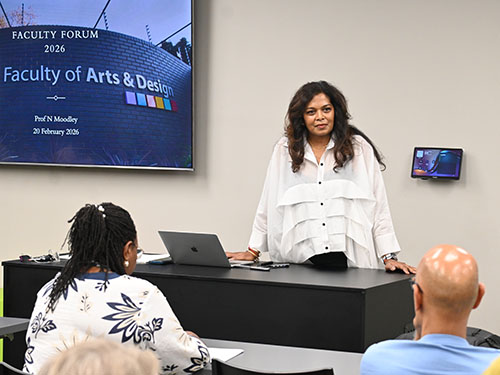 Prof Nalini Moodley, Executive Dean of Tshwane University of Technology’s Faculty of Arts and Design, engaged her staff on the Faculty’s strategic direction for 2026 during the Faculty Forum on 20 February.
Prof Moodley outlined the Faculty’s strategic direction for 2026 at the Faculty Forum on 20 February, highlighting exciting projects and how the Faculty will align its work with that of the strategy of the university. She also included a critical reflection on how the Faculty fared in 2025.
In her presentation, aimed at bringing the Faculty into shared purpose and possibility, she outlined five global shifts that drive the demand for collaboration: the globalisation of education and research, changing labour market demands (graduates needing interdisciplinary, globally minded skills), complex societal challenges and mission imperatives, digital disruption and new pedagogies, and resource pressures and financial sustainability (increased competition, limited resources, rising costs and austerity measures).
True to her solution‑driven nature, she identified several creative collaborations staff could embrace. These include joint research, industry residencies, cross‑disciplinary studios and a week of creative collaboration once per semester.
“Students should be our focus: collaborate with them, avoid transactional teaching and be present in our ever-changing lecture halls. We need to expand our collaboration with technologies and AI in order to enhance our engagements with students,” Prof Moodley said.
She commended staff for success and graduation rates that compare favourably with Department of Higher Education and Training (DHET) norms. For instance, the Faculty’s success and graduation rates for 2025 stand at 87% and 27.8%, respectively.
The Faculty’s efforts to bolster research and creative output are also yielding results. In 2025, research publications stood at 37 units and creative outputs at 52, more than doubling from the previous year.
Improvements in staff qualifications are also on the rise, with 34 staff members holding Master’s degrees and 20 Doctorates in 2025.
Coupled with strong community engagement projects planned for 2026 – such as the Red Mango Arts Festival and the Clarens Arts Festival –several exciting initiatives are planned, including artists-in-residence programmes, a graduate employability survey, a writing-lab initiative provocatively titled ‘Shut Up and Write,’ the African Theatre Association conference (AfTA), the 3rd Annual GBVF Symposium, the 2nd International Artivism Conference and the eighth rendition of the TUT Arts Festival.
The search for the elusive dedicated art gallery for the Faculty is still on the agenda.
Touching on the funding challenges facing the arts sector, Prof Moodley also stressed the need to generate third‑stream income through, among other avenues, Short Learning Programmes (SLPs), masterclasses and workshops.
In terms of improving the Faculty’s teaching and learning offering, Prof Moodley identified key focus areas for the year, including expanding online qualifications, re-curriculation to revise and update its current Programme and Qualification Mix (PQM) and maximising the use of the advisory boards. Additional priorities include leveraging technology (especially Artificial Intelligence), revising and increasing the use of the lecturer evaluation tool and implementing the class attendance and participation policy.
The Faculty Forum was framed against the TUT Institutional Strategic Plan 2026 – 2035, visioning An entrepreneurial university of technology, shaping the future.