Doctoral candidate among TUT Artivism Conference's young voices
Academics
5 October 2026
By Gerrit Bester
The 2026 Artivism Conference, Reimagining Futures, brought together artists, activists and scholars from around the world to explore how creative practice can challenge injustice and imagine new possibilities. Among the emerging voices was Maanbu Thalapathi (27), a doctoral candidate in TUT's Faculty of Arts and Design, whose journey from Chennai, India, to Pretoria reflects TUT's growing appeal to international researchers.
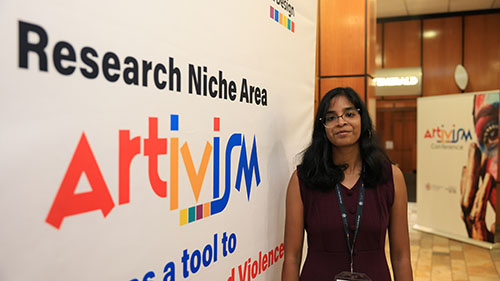 Maanbu Thalapathi (27), a doctoral candidate in the Faculty of Arts and Design at TUT, was one of the young voices featured at the TUT Artivism Conference.
Originally from Chennai in the southern Indian state of Tamil Nadu, Thalapathi began her PhD in Performing Arts remotely in June 2025 under the supervision of Professor Chats Devroop, Research Professor in the Faculty. She arrived in South Africa on 1 September to continue her studies on campus.
Maanbu Thalapathi (27), a doctoral candidate in the Faculty of Arts and Design at TUT, was one of the young voices featured at the TUT Artivism Conference.
Originally from Chennai in the southern Indian state of Tamil Nadu, Thalapathi began her PhD in Performing Arts remotely in June 2025 under the supervision of Professor Chats Devroop, Research Professor in the Faculty. She arrived in South Africa on 1 September to continue her studies on campus.
Her doctoral research, The Representation of Female Musicians in Tamil Cinema between 1950 and 2025, examines the portrayal of women artists in one of the world's most prolific film industries.
Her path to TUT began through a personal connection and a search for the right academic fit.
"I got to know about TUT through a friend who is my husband's childhood friend," she explains. "I was looking for the right supervisor, and that led me here."
For Thalapathi, who completed both her undergraduate and postgraduate studies in English in India, the move marks a significant new chapter in both her academic and personal life. It has also offered a glimpse into a different cultural and educational environment.
"The people I've encountered have been very nice," she says. "I haven't been out much yet, but I enjoy walking around the Arts Campus. What appeals to me is that the campus brings together so many different disciplines. The students are extremely talented."
Beyond academia, music has always been central to her life. Her father owns a recording studio and she grew up immersed in musical culture. She also received formal training as a singer, completing her Licentiate qualification in Western Classical Vocal Performance through Trinity College London.
"I grew up with music," she says. "It's a normal part of life for me. Music is a universal language."
That lifelong connection to music is clearly evident in the research she presented at the Artivism Conference. In her paper, Arivu and Gaana: The Anti-Caste Artivism Agenda, Thalapathi explored how Tamil rapper and lyricist Arivu has transformed traditional musical forms into powerful tools of social activism.
Her work examines how Arivu draws on gaana, a folk genre historically associated with working-class communities in North Chennai, bringing it into mainstream popular culture while simultaneously addressing the realities of caste discrimination.
"He brings traditional genres that have historically been marginalised into the mainstream," she explains. "At the same time, he uses them to address caste politics."
The caste system remains one of India's most enduring social challenges. Although complex and deeply rooted in history, it continues to shape social relationships and opportunities for many communities.
Drawing on examples such as Jai Bhim Anthem, Quota Song, Therukural and the globally recognised hit Enjoy Enjaami, her presentation demonstrated how music can amplify marginalised voices and bring issues of social justice into public conversation.
For Thalapathi, these themes resonate far beyond India.
"South Africa goes through a parallel experience," she says. "I wouldn't say one situation is worse than the other, but the segregation South Africa experienced is quite close to some of the caste divisions that India faces. Elements of both are still active in both countries."
It is this ability to connect local struggles to broader global conversations that made her contribution particularly relevant to the conference theme. Her research illustrates how creative activism can emerge from specific cultural contexts while speaking to universal questions of identity, dignity and human rights.
As one of the younger scholars participating in the conference, Thalapathi was inspired by the diversity of perspectives represented throughout the programme.
"There are a lot of problems in the world," she reflects. "It's fascinating to see so many different perspectives on so many different problems."
The conference experience also exposed her to new intellectual traditions. Among the ideas she hopes to explore further is Ubuntu aesthetics, a concept rooted in African philosophies of interconnectedness and collective humanity.
Her participation therefore became more than simply presenting research. It represented a meaningful exchange of ideas between South Africa and India, highlighting the value of international academic mobility and cross-cultural dialogue.
Currently residing at Kosmos Guest House in Sunnyside, she admits that life away from home has not always been easy.
"I miss my family and friends, especially my husband, Sanjay," she says.
Yet her focus remains firmly on completing her doctorate, which she hopes to finish during the first half of next year. Looking further ahead, she sees a future in academia, although she remains open to wherever the journey might lead.
"We'll see what the future holds. Anything can happen."
Perhaps the most powerful message from her presentation was also the most personal. While studying artivism and social change is important, she believes the real challenge lies in turning ideas into action.
"To myself, I would say: don't let artivism stop with the presentation," she reflects. "Follow through. I would like to be braver and do that because the issues are daunting."
📷 Vishern Debiky