Decade of rail innovation delivers results
Academics
17 August 2026
By Mosima Rafapa
For a decade, cutting-edge research, technology development and skills training have helped shape South Africa's passenger rail sector and that impact recently came into sharp focus during the Gibela Research Chairs Roadshow. The event showcased innovative projects, industry-driven solutions and collaborative initiatives that are strengthening localisation, advancing rail manufacturing and developing future rail engineering talent.
 TUT Gibela Research Chair, Prof Tshifhiwa Nenzhelele, highlighted how industry-academic collaboration is advancing rail innovation, localisation and skills development.
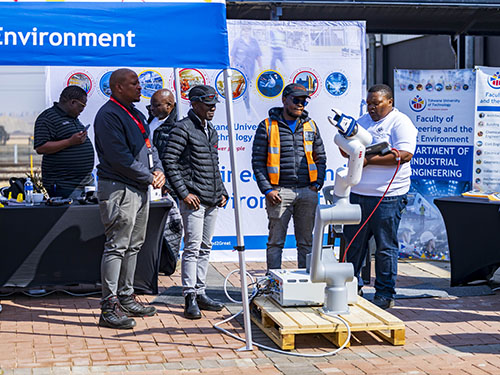
The Faculty of Engineering and the Built Environment's Department of Industrial Engineering and the Stellenbosch University Research Chair participated in the two-day Gibela Research Chairs Roadshow, hosted at the Gibela manufacturing plant in Dunnottar, Nigel and the Gibela Midrand Service Centre.
TUT Gibela Research Chair, Prof Tshifhiwa Nenzhelele, highlighted how industry-academic collaboration is advancing rail innovation, localisation and skills development.
The Faculty of Engineering and the Built Environment's Department of Industrial Engineering and the Stellenbosch University Research Chair participated in the two-day Gibela Research Chairs Roadshow, hosted at the Gibela manufacturing plant in Dunnottar, Nigel and the Gibela Midrand Service Centre.
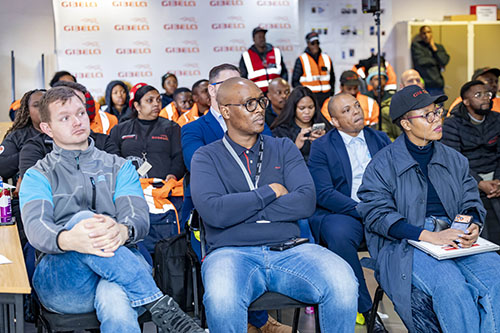
Held under the theme Engineering the Future of Rail: Rail Solutions for Practical Industry and Academic Collaboration, the roadshow gave Gibela employees an opportunity to engage with research projects, technological developments and innovations designed to support South Africa's passenger rail industry. Engineers, artisans, tradespeople and production-line employees interacted directly with researchers and gained insight into how academic research supports day-to-day operations and long-term industry growth.
Prof Tshifhiwa Nenzhelele, Gibela Research Chair, said the roadshow demonstrated the value of sustained collaboration between academia and industry.
"Our role extends beyond conducting research. We are developing technologies, building industry capacity, creating opportunities for students and supporting localisation in ways that contribute to a stronger and more sustainable rail sector. Working closely with industry ensures that our research addresses real challenges while preparing the skilled professionals the sector needs for the future."
Dr Ragosebo Kgaugelo Modise, Project Coordinator from the Department of Industrial Engineering, reflected on the Chair's achievements over the past decade and its growing contribution to the rail industry.
 Dr Kgaugelo Modise reflected on a decade of achievements by the TUT Gibela Research Chair and its contribution to the rail industry.
She said the Chair has secured more than R7 million, which has been reinvested in staff development, student training and research activities. It has also attracted additional industry stakeholders and established Memoranda of Understanding that have created student placement opportunities while strengthening collaboration between universities and industry.
Dr Kgaugelo Modise reflected on a decade of achievements by the TUT Gibela Research Chair and its contribution to the rail industry.
She said the Chair has secured more than R7 million, which has been reinvested in staff development, student training and research activities. It has also attracted additional industry stakeholders and established Memoranda of Understanding that have created student placement opportunities while strengthening collaboration between universities and industry.
Beyond research, the Chair has supported community development by providing career guidance to high school learners and creating five employment opportunities through the appointment of administrative staff, student assistants and a project coordinator.
Dr Modise also highlighted the success of the Chair's partnership with the International Union of Railways, which led to the inaugural Commuter and Regional Train Services Training programme hosted in May. The initiative attracted new stakeholders, including the Department of Transport, and resulted in the Chair contributing to discussions on the draft National Rail Master Plan.
Another milestone is the Lean Six Sigma Green Belt short learning programme, which has already benefited City of Tshwane officials and participants from the Manufacturing, Engineering and Related Services Sector Education and Training Authority (merSETA). The programme is now offered to third-year Operations Management students, helping to strengthen industry-relevant skills.
 TUT, together with the Stellenbosch University Research Chair, participated in the two-day Gibela Research Chairs Roadshow on 29 and 30 July.
She added that the Chair has enhanced research excellence by hosting intensive journal-writing workshops that have significantly increased publication output.
TUT, together with the Stellenbosch University Research Chair, participated in the two-day Gibela Research Chairs Roadshow on 29 and 30 July.
She added that the Chair has enhanced research excellence by hosting intensive journal-writing workshops that have significantly increased publication output.
"The Research Chair was established to develop practical localisation solutions through technology development and knowledge transfer. Over the years, that mandate has expanded to include supplier development, student and researcher support, prototype development, commercialisation, international collaboration and research that delivers tangible value to the rail industry."
Dr Modise said the Chair is currently addressing 12 challenges identified by Gibela, focusing on new product development, process improvement and energy management. The projects draw on expertise from technology stations, the Rail Manufacturing Centre for Entrepreneurship Rapid Incubator (RMCERI) and several academic disciplines to develop practical solutions for the sector.
Dr Buyiswa Mncono-Liwani, Corporate Services and Traction Motors Operations Executive at Gibela Rail Transport Consortium, highlighted how the TUT Gibela Research Chair has leveraged student expertise to support industry-focused research and help solve production-line challenges.
 Vuyiswa Tlomatsane welcomed the Research Chairs, highlighting the importance of research partnerships in strengthening localisation and innovation.
Vuyiswa Tlomatsane, Service Operations Executive at the Gibela Rail Transport Consortium, welcomed the TUT and Stellenbosch University Research Chairs to the Gibela Midrand Service Centre and described the visit as an important opportunity to connect employees with research activities.
Vuyiswa Tlomatsane welcomed the Research Chairs, highlighting the importance of research partnerships in strengthening localisation and innovation.
Vuyiswa Tlomatsane, Service Operations Executive at the Gibela Rail Transport Consortium, welcomed the TUT and Stellenbosch University Research Chairs to the Gibela Midrand Service Centre and described the visit as an important opportunity to connect employees with research activities.
She said the exhibitions helped employees better understand ongoing research and its role in supporting Gibela's localisation drive.
"A key focus of our research is to localise as much as possible in both our train design and our services business."
Tlomatsane explained that the Midrand Service Centre manages Level 4 maintenance operations and hosts key functions, including engineering, industrial supply chain, warranty, fleet support and the main spare parts warehouse. Its Fleet Support Centre remotely monitors train operations and provides technical support to depots across the rail network.
She said the Midrand facility currently serves as Gibela's central service hub, with similar centres planned for the Western Cape and KwaZulu-Natal as operations expand.
According to Tlomatsane, partnerships with the two Research Chairs continue to strengthen localisation, innovation, and skills development, supporting the long-term goal of increasing local manufacturing of rail products and components.
 Dr Buyiswa Mncono-Liwani acknowledged the valuable contribution of TUT students to solving real industry challenges through research.
 TUT Gibela Research Chair, Prof Tshifhiwa Nenzhelele, engages with Prof Annie Bekker, the Stellenbosch University Gibela Engineering Research Chair.
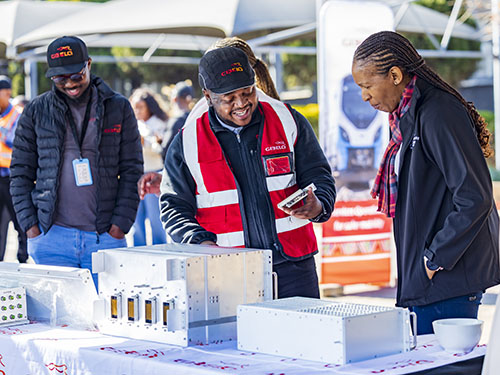
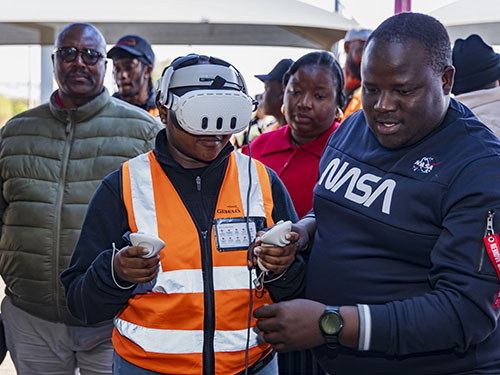
These are some of the exhibitions during the Gibela Research Chairs Roadshow.