Can anything be more beautiful than a library?
Desk of the VC - Prof Tinyiko Maluleke
12 March 2026
By Prof Tinyiko Maluleke, Vice-Chancellor and Principal
We are gathered here to do something rare and beautiful; something during which we will also make a bit of history. Talking about history, let me go back a bit to the brief history of libraries.
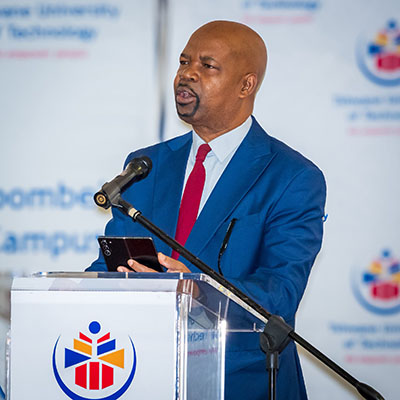 Vice-Chancellor and Principal Prof Tinyiko Maluleke says a modern library must contain much more than books on shelves.
From the 7th Century when one of the oldest library in the world, the library of Assyrian ruler Ashurbanipal, was built in Nineveh (now part of modern-day Iraq), human beings have constantly been experimenting with ways to seek, find and preserve knowledge. Indeed, the very art of reducing thoughts, language, ideas, and stories into writing; led to the creation of the original (mini) libraries – the stone tablets and the papyrus scrolls on which the earliest texts were written.
Vice-Chancellor and Principal Prof Tinyiko Maluleke says a modern library must contain much more than books on shelves.
From the 7th Century when one of the oldest library in the world, the library of Assyrian ruler Ashurbanipal, was built in Nineveh (now part of modern-day Iraq), human beings have constantly been experimenting with ways to seek, find and preserve knowledge. Indeed, the very art of reducing thoughts, language, ideas, and stories into writing; led to the creation of the original (mini) libraries – the stone tablets and the papyrus scrolls on which the earliest texts were written.
The Ashurbanipal library was nothing more than a carefully arranged collection of tablets containing various ancient scholarly writings and stories. Apparently, King Ashurbanipal kept his stone tablets under lock and key, complete with warnings that anyone who dared steal them would suffer the wrath and curse of the gods.
From the 7th century to today, libraries remain as enigmatic as they are emblematic of the insatiable human quest for knowledge. Until today, libraries have retained the role of sacred repositories of knowledge. For this reason, in various societies, libraries are housed in some of the most stunning architectural buildings. One only has to see the splendour and the majesty of the buildings of libraries of Alexandria in Egypt; the Library of Congress in the US, La Bibliothèque National de France in Paris; the Vatican Library in Rome, and the National Library of China in Beijing.
From time immemorial, libraries have been, and they remain, the engines of intellectual pursuit, contemplation and excellence. Next to the home, the school and the University, the library is the preeminent place of learning for the young (and the old). Indeed, before there was school or university, there was a library. If the hardcopy book is the original memory stick, the library is the original data centre. It still is.
The end of the library?
As it was with those who incorrectly predicted that television would put radio out of business; and those who wrongfully predicted that social media, podcasts, and the internet would put an end to both radio and television; there are those who are predicting the end of the physical book and the end of the physical library. They, too, may soon be proven wrong.
Of course, the library, like all the great inventions of humanity over the past thousand years, must adopt and adapt to new technologies. Of course, the internet has created a powerful, vast online library that is now virtually accessible on demand, thanks to machines that are “scary smart”, which is the title of Mo Gawdat’s 2021 book on AI. Of course, library spaces may no longer be dedicated solely to contemplative physical reading. Because there are so many more ways, places and spaces to read, the library must become a multipurpose place, inclusive of social space, idea labs, podcast recording centres, discursive spaces, gaming areas, coffee-shop-like precincts etc - in short, a 21st Century library must contain much more than books on shelves.
Malls Everywhere and Not a Library in Sight
Across the length and breadth of our country; villages, squatter camps, townships, platteland dorpies and cities are sagging at the seams, under the weight of malls and shopping centres of all shapes and sizes. Indeed, we can plot a map of our country using the malls and shopping centres scattered across the land – from Menlyn in Pretoria to the Mall of Africa in Midrand to the Gates of Johannesburg: North Gate East Gate and South Gate to the Pavillion in Durban and all the way to the Canal Walk in Cape Town.
It is raining malls, but there is a drought of libraries.
In this corridor city of Mbombela, the malls are too numerous to list in full: Riverside Mall, iLanga Mall, the Grove Retail Shopping Centre, Promenade Shopping Centre, Nelspruit Crossing, Mbombela Centre, Westend Shopping Centre, Central Park Shopping Centre, the Square Shopping Mall, Rapid Falls Value Centre, Besterbrown Shopping Centre, Sonpark Shopping Centre, eKukhanyeni Shopping Centre … to mention but a few.
By way of contrast, the number of libraries in this city can be counted by the number of fingers on one’s hand.
This city would be better off if it had as many libraries as it has shopping centres. The villages of Mpumalanga and all other provinces would be better off if they had more libraries than taverns and shopping malls. I think the youth of Mpumalanga and everywhere else in the country would be better served by libraries than the hubbly they puff, the drugs they use and the liquor they imbibe before they die prematurely. If only we could swap the malls and the taverns for libraries, learning centres and innovation hubs.
Conclusion
In the beginning, there was a library. And so I say unto you, ‘seek ye first the freedom of the library and all these other things shall be added unto you’.
A few years ago, I knew a young man whose first University workstation, as a part-time research assistant, was inside the library. The young man fell so in love he became a curious seeker of knowledge. On some days, he would wrestle with the contents of a book late into the night, inside the library, so that he would often sleep there - especially on days when he lacked the taxi fare to Tembisa township. That was in the Muckleneuk Library of the University of South Africa. I was that young man. In a way, I have never left the library.
You see my friends, we can shout our famous TUT slogans till we are dark-blue in the face; but without functioning libraries, there will be no university that makes knowledge work because there will be no knowledge to work with to begin with; without 21st century libraries we cannot empower people; without modern libraries we will not only fail to move from good to great, we won’t move at all, we won’t move ourselves and we won’t move nobody; and without diligent and strategic library science leaders; there will be no future of work for our students, and no entrepreneuring - no future at all. The secret to the future of this university and this country is the library. Libraries and librarians are the bulwark that is our last defence against the vagaries of ignorance and underdevelopment.
Colleagues, students, fellow TUTzens, and you who work in the TUT library science space: whatever you do, please do not waste this library; please do not let it go to waste; you dare not allow the library and yourselves to waste away.
Tell me, is there anything more beautiful than a library? Oh, how beautiful it is, this thing we are doing today!
Delivered on 10 March 2026 at the launch of the Mbombela Campus Library
 Prof Tinyiko Maluleke officially opens the Mbombela Campus Library.