Book explores how Indians harnessed music as political resistance
Academics
10 February 2026
By Gerrit Bester
The intricate link between music and identity in Indian communities in SA, during and after apartheid, is central to the new book Raag Mala – Indian Voices in Apartheid South Africa (1900–1990).
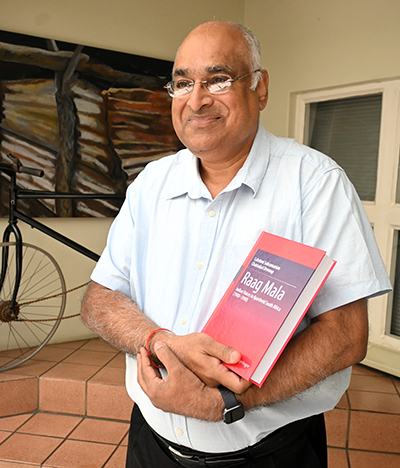 Prof Chatradari Devroop, Research Professor at the Faculty of Arts and Design, displays a new book, Raag Mala – Indian Voices in Apartheid South Africa (1900 –1990), which he co-authored.
Co-authored by Prof Chatradari Devroop, Research Professor in the Faculty of Arts and Design at the Tshwane University of Technology (TUT), the work offers an overview of existing research on music and Indian diasporic communities, while highlighting the unique challenges Indian South Africans have faced in accessing and preserving their musical traditions.
Prof Chatradari Devroop, Research Professor at the Faculty of Arts and Design, displays a new book, Raag Mala – Indian Voices in Apartheid South Africa (1900 –1990), which he co-authored.
Co-authored by Prof Chatradari Devroop, Research Professor in the Faculty of Arts and Design at the Tshwane University of Technology (TUT), the work offers an overview of existing research on music and Indian diasporic communities, while highlighting the unique challenges Indian South Africans have faced in accessing and preserving their musical traditions.
Raag Mala, a term from Indian classical music describing a garland of melodic frameworks woven together, reflects the authors’ aim to intertwine diverse musical stories into a cohesive narrative.
The book stands as a significant resource for academics and music enthusiasts intrigued by the culture of the Indian diaspora and the history of Indian South Africans. It explores the historical soundscapes of South Africa, detailing how the restrictive conditions of apartheid shaped social interactions and music-making.
“The narrative examines how Indians used music as a form of political resistance, developing a distinct Indian South African sound despite severe limitations. It also traces the evolution of popular genres – qawwali, filmi, jazz and dance music – shaped by limited access to formal training and the pervasive use of technology. Additionally, the book addresses gender dynamics within the music industry, focusing on the struggles of women artists,” Prof Devroop notes.
“Furthermore, it discusses the role of technology in music learning and its impact on aesthetic expression. Through interviews with musicians, the book offers a vivid account of how Indian South Africans used music to assert their identity and resist segregation. It provides valuable insights into cross-cultural interactions and the nuanced ways minority groups crafted their identities within the context of apartheid politics.”
The book is organised thematically into five chapters, each illuminating a distinct facet of the Indian South African musical experience during apartheid.
The first chapter provides an overview of the emerging soundscapes among Indians in South Africa, situating musical practices within the broader historical context of migration and settlement.
The second chapter examines how music functioned as a form of resistance under apartheid.
The third chapter focuses on questions of musical learning and genre formation.
The fourth chapter addresses the gender dimensions of musical practice.
The fifth chapter explores the politics and aesthetics of transnational music in the diaspora.
“Throughout these chapters, you’ll hear directly from the musicians through extensive quotations from our interviews. These first-person narratives form the heart of the book, offering intimate perspectives on creative and cultural life during this challenging period,” says Prof Devroop.
The book features 40 interviews and took ten years to compile. Careful double-checking with the interviewees and their families was required to verify the information.
Prof Devroop’s collaboration with co-author, Prof Lakshmi Subramanian, began when one of them readily responded to the idea of recording a history of South African Indian voices, sharing interviews and insights that would prove invaluable to this project.
“The heart of this book lies with our interviewees, who were simply amazing in their contributions and even helped with revisions of the transcribed interviews.”
Retired as a professor of History from the Centre for Studies in Social Sciences, Calcutta, India, Prof Subramanian holds the position of Associate Fellow at the Institute of Advanced Studies, Nantes. Her specialisation is in economic and maritime history, as well as in the music and performing arts of twentieth-century South Asia.
Like Prof Devroop, she has numerous publications to her name.
Raag Mala – Indian Voices in Apartheid South Africa ( 1900 – 1990) is published by Springer and available from Raag Mala: Indian Voices in Apartheid South Africa (1900 – 1990) | Springer Nature Link