Artivism can help transform society, says TUT’s Prof Maharajh
Academics
7 August 2026
Understanding and addressing Gender-Based Violence and Femicide (GBVF) requires society to confront the deeper structural inequalities embedded in contemporary social and economic systems, according to Prof Rasigan Maharajh, Professor of Public Affairs at the Tshwane University of Technology (TUT) Faculty of Humanities. He delivered the closing keynote address at the 3rd annual Gender-Based Violence and Femicide (GBVF) Symposium hosted by the TUT Faculty of Arts and Design on 7 August.
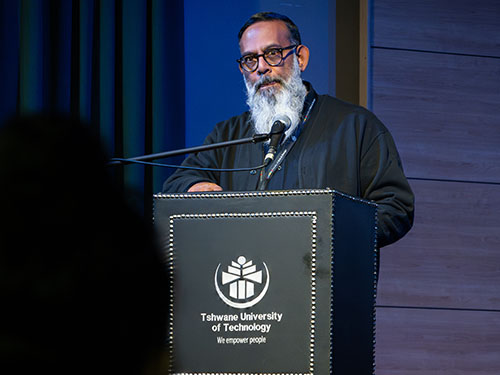 Prof Rasigan Maharajh. PHOTO: Thabo Dlamini
Speaking on The Contemporary Structural Violence of Patriarchy: Artivism as a Counter-Hegemonic Praxis for Transformative Social Knowledge Development, Prof Maharajh argued that GBVF should not be viewed in isolation, but as part of a broader patriarchal political economy that reproduces inequality and exclusion.
Prof Rasigan Maharajh. PHOTO: Thabo Dlamini
Speaking on The Contemporary Structural Violence of Patriarchy: Artivism as a Counter-Hegemonic Praxis for Transformative Social Knowledge Development, Prof Maharajh argued that GBVF should not be viewed in isolation, but as part of a broader patriarchal political economy that reproduces inequality and exclusion.
Reflecting on his own experiences as a student activist during the anti-apartheid struggle of the 1980s, Prof Maharajh described how art and design influenced his contribution to the mass democratic movement and national liberation struggle.
"My contribution to our collective struggles for freedom was, and remains, heavily influenced by art and design," he said.
Drawing on Karl Marx's observation that people make history under conditions inherited from the past, Prof Maharajh emphasised the importance of understanding the historical roots of present-day inequalities. He paired this perspective with art historian Amy Herman's concept of "visual intelligence," which she defines as the ability to assess, analyse, articulate and adapt to visual information.
"It is in response to enhancing our visual intelligence that my presentation sets out some critical empirical and objective aspects of our contemporary conjuncture," he explained.
Prof Maharajh painted a picture of a world characterised by profound inequalities. Referring to global wealth data, he noted that a small minority controls a disproportionate share of the world's resources, while women continue to experience significant economic disadvantages.
According to the data cited in his address, women still earn only around 30% of total global labour income and carry a heavier burden of unpaid care and domestic work. He noted that this labour often remains invisible because it is excluded from national accounting systems.
Prof Maharajh argued further that gender inequality is sustained by structural and social barriers rather than just individual choices. These include unequal access to childcare, discrimination in hiring and promotion, occupational segregation and the underrepresentation of women in senior positions and higher-paying sectors.
Turning to South Africa, Prof Maharajh highlighted the country's own gendered challenges. He pointed to labour market statistics showing that women experience higher rates of unemployment than men, with African women facing the greatest vulnerability (40,5% unemployment). Young women, in particular, remain disproportionately affected by exclusion from employment, education and training opportunities.
He cautioned that these realities form part of a broader crisis of social reproduction, where unemployment, poverty, inequality and social alienation intersect to reinforce patriarchal power relations and social instability.
As the keynote drew to a close, Prof Maharajh shifted his focus to the role of universities, researchers, artists and designers in addressing these challenges. He expressed concern about South Africa's low levels of investment in research and development, arguing that knowledge production is critical to building an economy and society capable of meeting contemporary challenges.
"Our science and technology institutions are currently under-resourced, not only in equipment but, more critically, in the employment of skilled human capacities and capabilities," he said.
Central to Prof Maharajh's message was the concept of Artivism, which he described as a means of drawing attention to objective social realities and challenging the systems that sustain inequality.
"Artivism demands that we utilise the capacities and capabilities we develop to draw attention to the objective conditions experienced and filtered through our various subjective lenses," he said.
He argued that art and design have the potential not only to illuminate society's challenges but also to inspire alternative futures.
"In our current cold and pessimistic times, as ecological precarities expand, as the corruption of politics becomes more exposed, as alienation threatens our social stability, and as our economy continues to reproduce racial capitalism, it is through art and design that we could contribute to better illuminating the problems we confront and, even with humility, offer pathways towards the realisation of the world we want, need, and must demand."
Concluding his address, Prof Maharajh invoked the legacy of the women who marched to the Union Buildings in 1956, highlighting how literature, drama, fine art and graphic art have preserved their struggles and inspired future generations.
"The struggle for our liberation continues, and Artivism has a major role to play in progressively advancing us all," he said.
His keynote brought the symposium to a close with a call for art, design and critical scholarship to move beyond awareness and become active tools in challenging the structural conditions that enable GBVF.
- Prof Maharajh is an elected member of the Academy of Science of South Africa and an Associate Research Fellow of the Tellus Institute. His career includes research and leadership in science, technology and innovation policy, higher education governance and South Africa’s democratic transition. He has published extensively and presented research internationally.