Architecture graduate redefines African spatial design with Master’s distinction
AcademicsOther
30 April 2026
By Mosima Rafapa
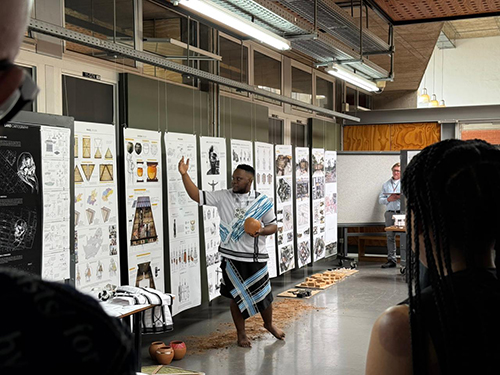
Siphesihle Made an Arcitecture student from the Tshwane University of Technology’s Faculty of Engineering and the Built Environment, graduated with a Master’s in Architecture, achieving 86% and advancing decolonial design that reimagines African spatial identity and challenges conventional approaches to space.
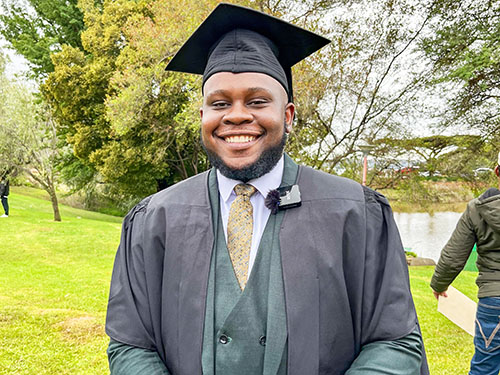 Siphesihle Made -mud bricks to Masters' success.
His research-driven study, titled Decolonial architecture: The design of a centre for indigenous advocacy in the City of Tshwane, proposes a shift in how space is understood and created. He presents a system rooted in Khoisan spatial practices that is modular, adaptable and temporary rather than fixed.
Siphesihle Made -mud bricks to Masters' success.
His research-driven study, titled Decolonial architecture: The design of a centre for indigenous advocacy in the City of Tshwane, proposes a shift in how space is understood and created. He presents a system rooted in Khoisan spatial practices that is modular, adaptable and temporary rather than fixed.
“It chooses to view land not as a commodity but as an ancestral entity so important that it cannot be claimed even by a building,” he says.
The design situates itself within historically colonial spaces in Tshwane, including Church Square and the Union Buildings. Instead of erasing these sites, it introduces an indigenous presence alongside them, creating, as he describes, a spatial dialogue.
“By inserting indigenous presence in spaces that were designed with the colonial project in mind, the project challenges the rights to land and space,” he says.
Made describes architecture as a platform for change. “Architecture can only provide the platform and stage for potential change. It dictates who belongs and who doesn’t,” he says.
He is the first in his family to graduate with a postgraduate degree, marking a significant milestone for his family.
“I am the first in my family to graduate with a postgraduate degree. It means a lot not only for myself, but for my family, who until two generations ago, had never had anyone study beyond matric,” he says.
He now works as a candidate architect at Stefan Antoni Olmesdahl Truen Architects and is also a part-time lecturer at TUT’s Department of Interior Design sharing his knowledge of African interior design with students and colleagues alike.
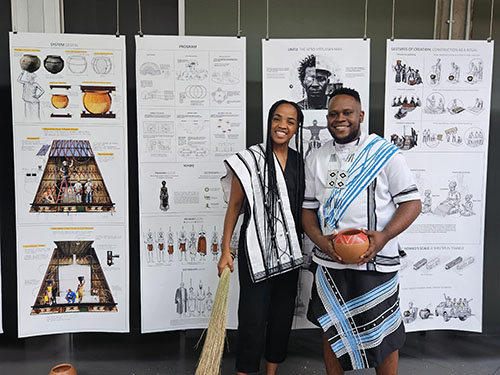 Hailing from Durban, with roots in Matatiele in the Eastern Cape, Made spent his childhood shaping mud bricks with his brother and building small houses.
“I have always been drawn to making and creating,” he says.
He discovered architecture as a career in Grade 10 through Engineering Graphics and Design and pursued it as a path to turn ideas into tangible spaces.
He began his studies in 2020 during the Covid-19 pandemic, which shaped his understanding of space even more.
“Studying space while being confined to a single one gave me a fresh and unique understanding of the importance of spatial design,” he says.
Throughout his studies, he developed a focus on socio-responsive design, influenced by lecturers including Victor Mokaba, Dr Sushma Patel, Dr Jako Nice, Tlhologello Sesana and Letlhogonolo Sesana.
His work also draws on personal identity and cultural influence.
“My grandmother was a lover of everything cultural. I inherited that love and grew to be sensitive to how undervalued our indigenous systems and cultures were,” he says.
For Made, decolonial architecture is a necessary shift in practice.
“We as African spatial practitioners have to put our own indigenous spatial practices as the main design drivers. African architecture cannot be relegated to others,” he concludes.