AI in healthcare, road management and agriculture under the spotlight at TUT AI Hub Seminar
Academics
12 October 2026
By Phumla Mkize
A study by Harvard University is showing how artificial intelligence (AI) can be used to predict which individuals will be severely affected by stopping their HIV treatment. The research is instrumental in determining patients' rebound rates, which can be driven by interrupted access due to cost, lack of funding for medicines, or lack of access to antiretroviral therapy.
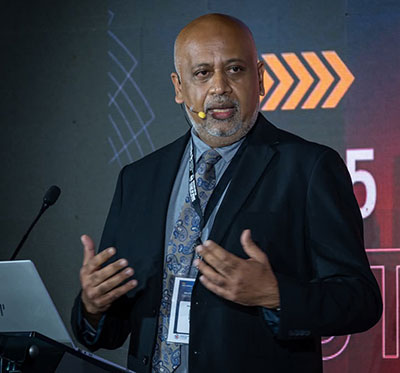 Prof Anish Kurien
The study was presented by Dr Malika Aid Boudries from the Harvard Medical School during the annual TUT AI Hub AI Seminar, which took place on 7 and 8 October 2026. The seminar was hosted in collaboration with the French South African Institute of Technology (F’SATI), which marked 30 years of collaboration between the two countries this year.
Prof Anish Kurien
The study was presented by Dr Malika Aid Boudries from the Harvard Medical School during the annual TUT AI Hub AI Seminar, which took place on 7 and 8 October 2026. The seminar was hosted in collaboration with the French South African Institute of Technology (F’SATI), which marked 30 years of collaboration between the two countries this year.
The seminar brought together industry, academia and government to talk about AI infrastructure, governance and social impact. It was attended by representatives from industry, including Google, IBM and Logiroad France, government officials, as well as academics from France’s Gustave Eiffel University (UGE), Paris-Est Créteil University (UPEC) and Harvard University.
It focused on AI governance and policy, AI in healthcare, and the use of AI to solve societal challenges.
Dr Alexandar Engels, a urologist from Henri Mondor Hospital in Paris and Professor at UPEC, highlighted augmented reality's role in assisting urologists in renal surgeries and in optimising hospital resources and facilities.
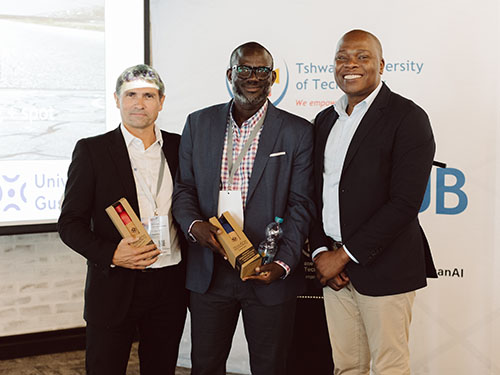 Dr Yann Goyat, Prof Lamine Dieng and Prof Mxolisi Shongwe.
The role of AI in the personalisation of rehabilitation and care in physiotherapy, biokinetics and occupational therapy also came under the spotlight, with physiotherapist Dr Nadia Latib and Assistant Dean for Research and Innovation in the Faculty of Science, Prof Yvonne Paul, highlighting the use of wearables and assistive devices to help patients recover. Prof Paul also underscored the importance of independent feedback from devices and Apps in providing a holistic view of treatment effectiveness.
Dr Yann Goyat, Prof Lamine Dieng and Prof Mxolisi Shongwe.
The role of AI in the personalisation of rehabilitation and care in physiotherapy, biokinetics and occupational therapy also came under the spotlight, with physiotherapist Dr Nadia Latib and Assistant Dean for Research and Innovation in the Faculty of Science, Prof Yvonne Paul, highlighting the use of wearables and assistive devices to help patients recover. Prof Paul also underscored the importance of independent feedback from devices and Apps in providing a holistic view of treatment effectiveness.
Prof Hanna Gharrad from the Laboratory of Transportation and Urban Planning Economics, ENTE in Lyon, France, presented how AI techniques can be used for parking availability prediction, which can have a considerable impact on vehicle emissions.
Exciting research on AI in road management was also presented at the seminar. Prof Lamine Dieng and Dr Yann Goyat from the UGE presented research on AI-based road surface monitoring. Dr Goyat, co-CEO of LogiRoad France, presented an AI-based monitoring tool developed at LogiRoad. The Tshwane University of Technology (TUT), in collaboration with UGE, has developed a low-cost device to assess road conditions. Presented by Prof Anish Kurien of the TUT AI Hub and Cornel Meyer, the device uses GPS and sensors to assess road deterioration and to suggest possible maintenance procedures.
Prof Andry Razakamanantsoa from UGE presented work on air quality monitoring and analysis and its impact on the health of individuals.
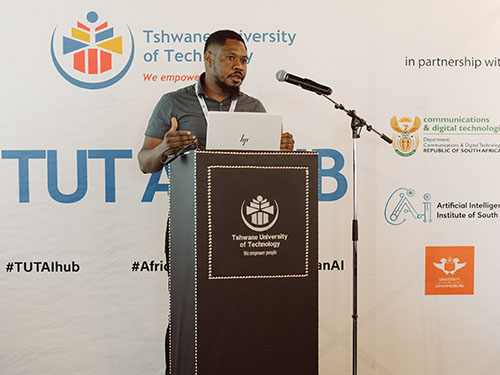 Dr Prosper Sotenga
AI was also presented as the big equaliser for small-scale farming, with small-scale farmers able to access data to inform soil and fertiliser decisions, presented by Dr Prosper Sotenga from TUT.
Dr Prosper Sotenga
AI was also presented as the big equaliser for small-scale farming, with small-scale farmers able to access data to inform soil and fertiliser decisions, presented by Dr Prosper Sotenga from TUT.
AI is also a game-changer for broiler farmers, enabling them to predict, control, and assess weight changes in chickens. Prof Nico Steyn from TUT presented a technology innovation developed to assist poultry farmers.
As AI becomes an omnipresent engine that drives global industry and research, the seminar highlighted how it can be used to solve societal problems.