AI governance journey gains momentum at TUT
Academics
18 August 2026
As artificial intelligence (AI) reshapes higher education, the Tshwane University of Technology (TUT) is taking decisive steps to ensure its adoption is responsible, ethical and aligned with the institution's strategic goals. To support this objective, the Acting Deputy Vice-Chancellor of Digital Transformation, Dr Emily Mabote, hosted a three-day AI Governance Workshop facilitated by the global IT research and advisory firm, Info-Tech Research Group.
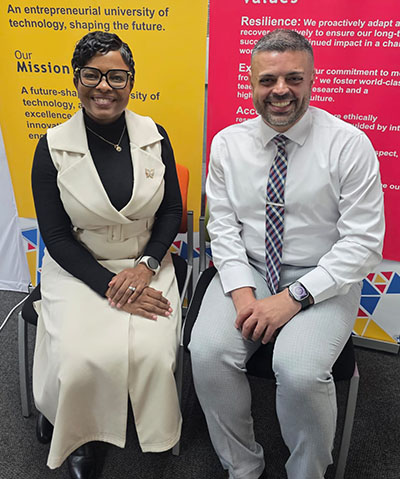 Dr Emily Mabote, Acting DVC for Digital Transformation, with facilitator, Emmett Moradi, Senior Technical Counsellor (Artificial Intelligence and Data) Info-Tech Research Group: A global IT research and advisory firm.
The workshop brought together stakeholders from across the University to establish a foundation for AI governance.
Dr Emily Mabote, Acting DVC for Digital Transformation, with facilitator, Emmett Moradi, Senior Technical Counsellor (Artificial Intelligence and Data) Info-Tech Research Group: A global IT research and advisory firm.
The workshop brought together stakeholders from across the University to establish a foundation for AI governance.
The workshop focused on developing a governance framework to guide the responsible use, management and oversight of AI across the institution. Through practical discussions and hands-on activities, participants reached consensus on key institutional risks, including data privacy, cybersecurity, academic integrity, intellectual property protection, reputational risk and the use of unapproved AI tools. These discussions contributed to the development of TUT's enterprise AI risk register and helped position AI governance as a strategic institutional priority.
During the workshop a strong foundation was established for AI governance by aligning TUT's approach with recognised frameworks and leading practices, including King V Principle 10, the National Institute of Standards and Technology (NIST) AI Risk Management Framework and the Protection of Personal Information Act (POPIA). In addition, of importance was also the co-design of a proposed AI governance structure, supported by a Data, Analytics and AI Governance Sub-Committee with clearly defined roles and responsibilities. The highly interactive workshop enabled participants to contribute directly to governance design, risk assessments and practical decision-making processes tailored to TUT's environment.
Participants also explored how TUT's AI initiatives can be aligned with the University's Integrated Strategic Plan (ISP) 2026-2035. In addition, they reviewed and proposed AI use cases that could strengthen student support, research excellence, administrative efficiency and institutional sustainability.
Speaking on the significance of the initiative, Dr Mabote emphasised that governance must be at the centre of the University's AI journey.
"Our goal is not simply to adopt artificial intelligence. We want to govern and apply AI responsibly in ways that advance student success, strengthen research excellence, improve operational effectiveness and protect institutional integrity," she said.
Looking ahead, TUT will focus on finalising the AI Governance Committee structure, completing the enterprise AI solution inventory and AI risk register, approving the Enterprise AI Strategy, as well as finalising the Institutional AI Governance and Responsible Use Policy.
As AI continues to transform higher education globally, TUT's proactive approach is positioning the University to embrace innovation while maintaining strong governance, responsible oversight and stakeholder confidence.
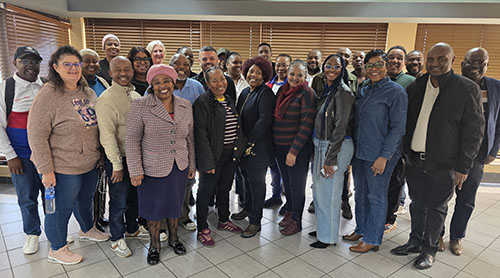 Participants from across TUT who attended the Artificial Intelligence (AI) Governance Workshop as part of the initiative to develop an institutional AI Strategy and Governance Framework from 15 to 17 July 2026, hosted by the Office of the DVC: Digital Transformation.