Access to technology and funding command the agenda at TUT’s 5th Annual Future of Work Dialogue
Academics
6 October 2026
By Phumla Mkize
Public digital infrastructure, entrepreneurship education, and funding are key to unlocking Africa’s next growth story. This is what speakers and panellists at the 5th Annual Future of Work Dialogue put forward as the missing link in advancing the continent’s development agenda.
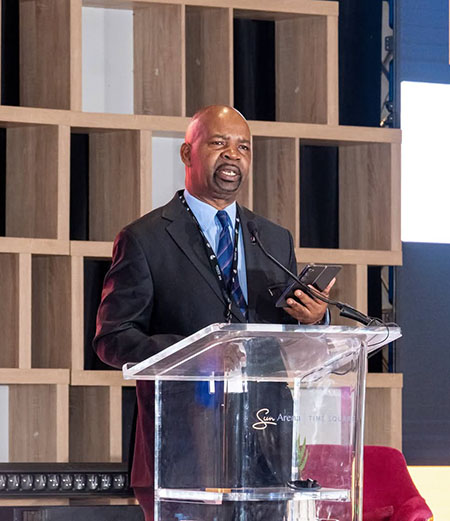 Vice-Chancellor and Principal Prof Tinyiko Maluleke.
The Dialogue, now in its fifth year, is hosted by the Tshwane University of Technology’s Institute for the Future of Work. It is a not-to-be-missed conversation that brings together government, academics, the private sector and civil society to find solutions for Africa’s development.
Vice-Chancellor and Principal Prof Tinyiko Maluleke.
The Dialogue, now in its fifth year, is hosted by the Tshwane University of Technology’s Institute for the Future of Work. It is a not-to-be-missed conversation that brings together government, academics, the private sector and civil society to find solutions for Africa’s development.
Held on 30 September and 1 October in Menlyn, in eastern Pretoria, the Dialogue highlighted some of the bottlenecks in unlocking Africa’s growth potential.
Tshwane University of Technology Vice-Chancellor and Principal, Prof Tinyiko Maluleke, said entrepreneurship education is key in developing Africa’s potential. He described entrepreneurship education as education deliberately designed to produce graduates who innovate to solve societal problems.
“Industry, business, government and societies that have no hand in the development of curriculum and in the creation of work-integrated learning experiences for students have themselves to blame when the graduates complete their qualifications but are neither employable, nor able to invent employment for themselves,” he said.
Prof Maluleke said entrepreneurship education is anchored around partnerships during every step of the learning journey. “In his endeavour professors work with businesspeople and industry practitioners off stage as they together map out the curriculum and on stage as they coteach, and the workplace becomes an extension of the classroom,” he said.
Tebogo Leshope, CEO of state-owned entity Sentech, underscored the role of digital infrastructure in enabling development and innovation.
Leshope said from 2030, South Africa will be more dependent on data, automation and connectivity with public services transitioning to digital platforms.
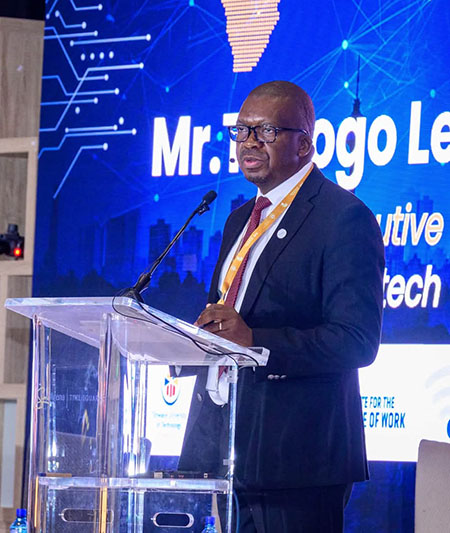 Sentech CEO Tebogo Leshope.
“We have to use our foresight correctly as leaders and engineers to make the relevant infrastructure and skills development investments today so that we are able to leverage the future opportunities correctly,” he said.
Sentech CEO Tebogo Leshope.
“We have to use our foresight correctly as leaders and engineers to make the relevant infrastructure and skills development investments today so that we are able to leverage the future opportunities correctly,” he said.
He added that in preparation for a digital future, Sentech is focused on building data centres with artificial intelligence capabilities. “To this effect, Sentech has built a data centre capability in Nasrec [Johannesburg]. We are now expanding this capability towards a sovereign capability that will be made available on an open-access basis to enable a localised and secure data centre capability,” adding that it will be available to customers, citizens and telecom operators.
“Connectivity is the bedrock upon which digital transformation and data exchange are enabled,’ he said, adding that South Africa has given sufficient focus to the creation of coverage, but it should now turn its attention to driving the cost of devices down. He lamented that South Africa is importing devices such as routers, calling for local manufacturing to drive prices down.
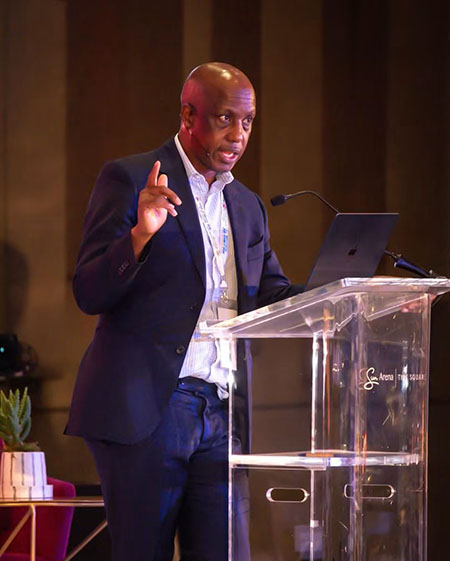 Letsholo Mojanaga from the United Nations Development Programme.
Letsholo Mojanaga from the United Nations Development Programme spoke on innovation financing, noting that nearly two decades after African heads of state committed to spending at least 1% of their gross domestic product on research and development (R&D), only Egypt has reached that target, with the rest of the continent averaging only 0.5%.
Letsholo Mojanaga from the United Nations Development Programme.
Letsholo Mojanaga from the United Nations Development Programme spoke on innovation financing, noting that nearly two decades after African heads of state committed to spending at least 1% of their gross domestic product on research and development (R&D), only Egypt has reached that target, with the rest of the continent averaging only 0.5%.
Mojanaga also noted that, with little private-sector involvement in R&D and donor funding, which comes with conditions, it is a struggle for African innovators to secure funding for their inventions.
Speakers at the conference included Deputy Minister of Trade, Industry and Competition Zuko Godlimpi, SABC CEO Nomsa Chabedi and Dr Ashwan Aggarwal from the International Labour Organisation.