A doctoral journey rooted in innovation and empowering the next generation
Academics
12 October 2026
By Kgothatso Monono
For many doctoral graduates, completing their degree marks the end of years of intensive research, long hours, and academic sacrifice. For Dr Fortunate Elesa Ntuli, however, the journey has also been about finding ways to make a difference beyond her research. Dr Ntuli was awarded a Doctor of Computing in Computer Systems Engineering during the Tshwane University of Technology (TUT) Spring Graduation ceremonies.
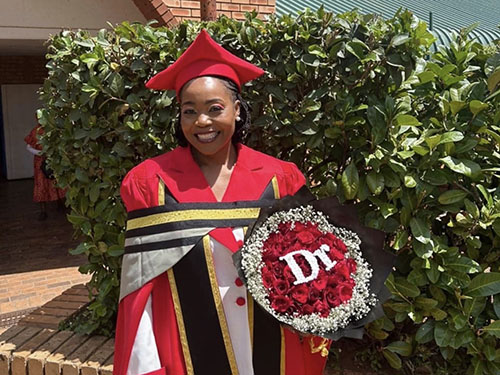 Dr Fortunate Elesa Ntuli is passionate about student development.
Her achievement is particularly significant because, while pursuing her doctorate, she continued to contribute to student development and the broader ICT community through initiatives that encourage young people to explore technology, innovation, and leadership.
Dr Fortunate Elesa Ntuli is passionate about student development.
Her achievement is particularly significant because, while pursuing her doctorate, she continued to contribute to student development and the broader ICT community through initiatives that encourage young people to explore technology, innovation, and leadership.
Dr Ntuli’s doctoral research focused on interference mitigation for spectrum-sharing networks, an area that addresses the growing demand for efficient use of wireless spectrum as more connected devices and technologies rely on wireless communication.
Her research resulted in the development of an AI-based real-time spectrum optimisation framework that combines several advanced technologies, including spectrum sensing, long short-term memory (LSTM) prediction, convolutional neural network (CNN)-based interference detection and deep reinforcement learning.
The results demonstrate the practical potential of the framework. It achieved approximately 94% detection accuracy, reduced decision latency to 15 milliseconds, and improved spectrum utilisation and throughput. In simple terms, the research explores how intelligent technologies can help communication networks more accurately identify interference and make faster decisions about how to use available spectrum.
But while Dr Ntuli was working on this highly technical research, she was also investing her time in something equally important: people. Dr Ntuli has been actively involved in the Faculty of ICT’s Girls in Tech initiatives, contributing to programmes designed to encourage and empower students, particularly young women, to see themselves as future participants and leaders in the technology sector.
Her involvement reflects a belief that developing technology is only part of building the future of ICT. Developing the people who will create, manage and lead that technology is just as important. She has also contributed to the Faculty’s Hacker Society activities, where she has engaged students on issues relating to technology, leadership, career development and opportunities within the ICT industry.
Her contribution to student development and innovation is not new. Dr Ntuli has been actively involved in the Tshwane Varsity Hackathon (TVH) since 2021, contributing to its growth as a platform for student innovation, digital skills development and entrepreneurship. She served as Chief Organiser from 2023 to 2024 and now serves as Digital Academy Lead from 2025, where she coordinates student activations, webinars, skills-development initiatives and post-hackathon incubation activities.
Through these roles, Dr Ntuli has supported collaboration between TUT, partner universities, industry and other stakeholders while helping students develop practical digital skills.
More recently, at the 2026 Faculty of ICT Research Day, she presented research focusing on generative AI and curriculum development in South African universities, reflecting her continued interest in emerging technologies and their impact on education. Her research journey, therefore, extends beyond a single doctoral project. It reflects an ongoing engagement with technologies that are changing the way people communicate, learn and work.