Small, continuous efforts move NRF-rated researcher from Y2 to C1
Academics
8 January 2026
He has had an exciting 2025. He was nominated for the TW Kambule-NSTF [National Science and Technology Forum] Award.
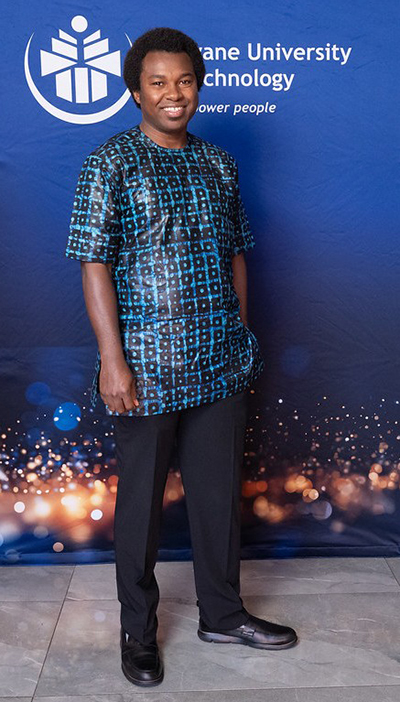 Dr Udochukwu Bola Akuru has developed and tested novel electrical machine prototypes and has received notable awards in his field.
He led the successful hosting of the 33rd Southern African Universities Power Engineering Conference (SAUPEC 2025) as General Chair. He registered as a Professional Engineer (PrEng) with the Engineering Council of South Africa (ECSA).
Dr Udochukwu Bola Akuru has developed and tested novel electrical machine prototypes and has received notable awards in his field.
He led the successful hosting of the 33rd Southern African Universities Power Engineering Conference (SAUPEC 2025) as General Chair. He registered as a Professional Engineer (PrEng) with the Engineering Council of South Africa (ECSA).
Dr Udochukwu Bola Akuru – whose research interests are advancing renewable energy technologies through the design and optimisation of innovative electrical machines – also received a special National Research Foundation (NRF) re-evaluation from Y2 (Emerging Researcher) to C1 Established Researcher. Phumla Mkize chats to Dr Akuru, Senior Lecturer in the Department of Electrical Engineering, about his NRF-rating upgrade.
It is a leap from Y2 to C1, what was your reaction when you received the news?
It was a moment of deep honour and gratitude, marking a major transition in my career from being recognised as an emerging researcher to being acknowledged as an established one with a sustained, high-quality and impactful research record.
I felt a profound sense of appreciation for TUT, particularly the Office of the Deputy Vice-Chancellor for Research, Innovation and Engagement and the Directorate of Research and Innovation, for supporting my special re-evaluation application. The upgrade validated years of consistent effort guided by my “Quantum Philosophy of Work”, which is based on the belief that small, continuous efforts compound into significant impact. Above all, I am thankful to God.
Was your Y2 rating in 2020 your first evaluation by the NRF?
Yes, this initial rating marked my entry into the NRF system as an emerging researcher.
Just applying for a special re-evaluation is a remarkable feat; take us through the motivation provided to the NRF.
My research output had grown significantly at the beginning of 2024, with over 80 Department of Higher Education and Training-accredited publications, multiple high-impact journal papers and presentations at top international conferences across the US, Europe, Russia, China and Africa.
I also responded directly to reviewer recommendations from my Y2 rating by publishing major review articles that helped establish me as a specialist in brushless wound-field flux-switching machine technologies. My grant portfolio at the time had expanded considerably. I was also leading and contributing to impactful projects while building an internationally visible research footprint. In addition, I developed and tested novel electrical machine prototypes and received notable awards in my field.
Tell us more about your research – and your research interests?
My research focuses on advancing renewable energy technologies through the design and optimisation of innovative electrical machines, especially brushless, magnetless wound-field and flux modulation machines. These machines offer high torque density, improved reliability and reduced dependence on expensive rare-earth materials, making them more sustainable and cost-effective.
I also work within broader themes such as renewable energy systems, microgrids, just energy transition, localisation of technologies and the circular economy. My interest lies in developing energy solutions that are both technically advanced and locally manufacturable to support sustainable development, reduce CO₂ emissions and promote industrial innovation.
Are you currently working on any special projects?
I am involved in several major projects. I am the principal investigator on the NRF Y-Rated Researcher Grant, which focuses on the design and feasibility of brushless wound-field machines for large-scale wind power over the period 2024 to 2026.
I am also the South Africa Lead and a Work Package Co-Lead in the £3.5-million Circular Economy Powered Renewable Energy Centre (CEPREC) project, funded by the UK Research and Innovation. The project investigates circular economy pathways for renewable microgrids in Africa. Additionally, I am part of a recently granted German Academic Exchange Service (DAAD) project consortium on just energy transition to run from 2026 to 2030.
What are your plans as an Established Researcher?
My goal is to continue contributing to renewable energy innovation through the design, prototyping and industrial-scale experimentation of brushless stator-excited wound-field machines. I aim to advance technologies that reduce dependence on rare-earth materials while improving cost-effectiveness, energy efficiency and reliability, especially for wind-power generation.
My plans also include strengthening technology localisation efforts, contributing to socio-economic development, expanding multidisciplinary collaborations and enhancing human capital development by mentoring students and junior researchers. I aim to support South Africa’s clean energy transition and global climate objectives through impactful research.
How do you balance your teaching demands with your research commitments?
It is a challenge as teaching remains a primary responsibility at TUT and takes considerable time. I manage this by working extended hours and by leveraging strong collaborations with local and international colleagues. These networks help accelerate research progress, especially when combined with the valuable contributions of my postgraduate students and postdoctoral researchers. Through careful time management, consistent effort and support from my research team, I can maintain productivity in both teaching and research.
What advice would you give to aspiring researchers – or current Y-researchers?
Find a mentor who genuinely cares about your growth. Be patient and willing to learn. Focus on excellence not glory, because excellence naturally follows diligent effort. Never reject opportunities, no matter how small or inconvenient they may seem – sometimes a single e-mail or event can open unexpected doors. Avoid shortcuts, remain prayerful, and stay resilient even when progress feels slow. Commitment, consistency and humility go a long way in shaping a successful research career.
What are the exciting developments in your field that we need to be on the lookout for in 2026 and beyond?
Some of the most exciting developments include advancements in the just energy transition, which is a major national priority in South Africa. This involves modelling sustainable energy scenarios, intelligent electricity forecasting and transitioning or connecting communities with clean energy technologies.
The circular economy is also becoming vital, particularly the repurposing of renewable energy technologies and managing the growing waste generated by distributed renewable systems and electrified transportation. In my core field of electrical machines, I hope to continue innovating on magnetless, brushless, stator-excited technologies to drive performance improvements and support medium-to-long-term industrial adoption.
Any other notable professional developments in 2025?
Yes, 2025 has been a productive year. I also attended the 124th Institute of Electrical and Electronics Engineers (IEEE) Region 8 Committee Meeting in Budapest as IEEE South Africa Section Chair and completed the 2024 IEEE Volunteer Leadership Training Programme.
For the third time in a row, I served as Co-Guest Editor for a special issue on mathematical modelling and numerical analysis, co-edited and published a special issue book available on Amazon. I also delivered several keynotes and webinars, presented papers at major international conferences including at IEEE Energy Conversion Congress & Expo (ECCE 2025) and graduated Cum Laude with a Diploma in Theology from Anchor University, Lagos.